Key facts
What is the GLOW Stack?
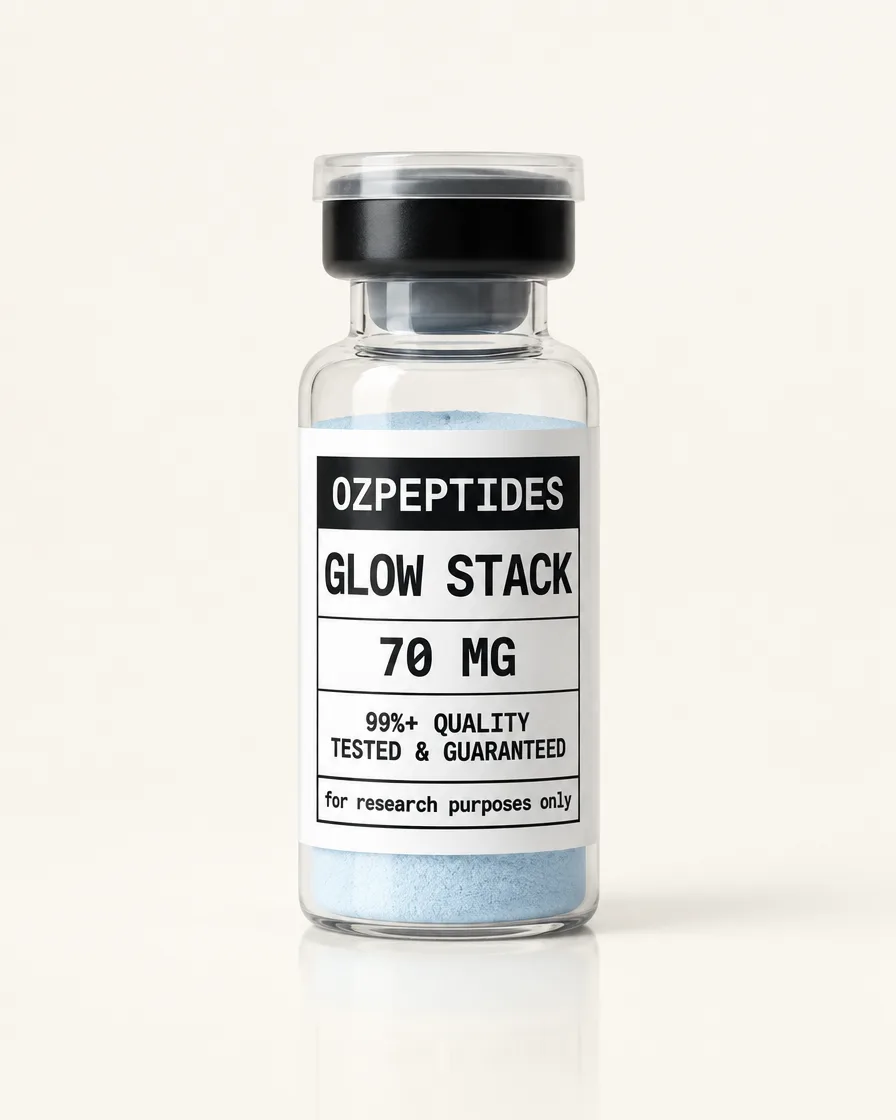
A single vial containing GHK-Cu, BPC-157 and TB-500, blended by weight and lyophilised together.
GLOW sits between the single compounds and the four-way KLOW blend. It leaves out KPV, the anti-inflammatory tripeptide, and keeps the three compounds most associated with structural repair and collagen research. Like all our blends it is prepared in our own lab and tested as a finished product rather than assembled from separately certified inputs.
Why these three compounds?
GHK-Cu for the collagen and copper-cofactor side, BPC-157 and TB-500 for the cell-migration and vascular side.
Skin repair research generally involves two strands: rebuilding the structural matrix, and getting the cells and blood supply there to do it. GHK-Cu addresses the first through copper-dependent crosslinking enzymes; TB-500 and BPC-157 are the most-studied compounds for the second. The combination is a mechanistic argument, not a tested product — no published trial covers this blend as such, and it would be dishonest to imply otherwise.
What is GLOW studied for?
Skin and cosmetic research, drawing on the literature for each component.
GHK-Cu has the deepest evidence base of the three in skin specifically, including collagen synthesis in fibroblast culture and wound models. BPC-157 and TB-500 contribute the soft-tissue repair literature, which is largely rodent work. For laboratory use, the blend's practical value is consistency and a single reconstitution.
Is GLOW approved in Australia?
No, and two of its three components are prohibited in sport.
None of the components is registered in Australia. BPC-157 (S0) and TB-500 (S2) are both named by WADA, so the blend is banned for athletes subject to anti-doping rules. OzPeptides supplies GLOW for in-vitro and laboratory research only, 18+, not for human consumption.
How is the blend quality verified?
Identity of all three peptides confirmed, purity by HPLC, heavy metals screened.
The blend is prepared by weight in our Australian lab and the finished product is tested, so the ratio we test is the ratio in the vial. Mass spectrometry confirms each component, HPLC measures purity, and contaminant metals are screened separately from the copper carried by GHK-Cu.
What is in GLOW, and what does each part do?
GHK-Cu for copper delivery and collagen crosslinking, TB-500 for actin binding and cell migration, BPC-157 for angiogenesis and growth-factor signalling. 70MG total peptide.
The three address different requirements of the same process. Copper is a required cofactor for lysyl oxidase, the enzyme that crosslinks collagen and elastin into load-bearing structure, which makes GHK-Cu the structural component and the one with the deepest research record — five decades of skin and wound-healing work. TB-500 reproduces the actin-binding region of thymosin beta-4, and cell migration depends on continuous actin assembly and disassembly. BPC-157 is associated with blood supply, chiefly through reported effects on VEGF receptor 2 expression and nitric-oxide signalling.
How does GLOW differ from KLOW?
KLOW adds KPV, an anti-inflammatory tripeptide, and runs at 80MG total peptide against GLOW's 70MG. The other three components are the same.
The choice between them is really a question about inflammation. GLOW covers structure, cell arrival and blood supply; KLOW adds an anti-inflammatory arm on top. If the research question involves inflammation, KLOW has a component addressing it; if it does not, the KPV is paying for something the work will not measure and GLOW covers the same mechanisms for less. KPV also produces no pigmentation effect despite deriving from alpha-MSH, since the pigment-active portion of the hormone is not in the fragment.
Has GLOW been studied as a blend?
No. No published study covers this blend, and the evidence for a combination is not the sum of the evidence for its components.
The rationale for combining these three is mechanistic — they are associated with different stages of tissue repair, so combining them is a reasonable hypothesis about complementary action. That is not a result. Interactions can be additive, redundant or antagonistic, and only a study of the combination distinguishes them. What the individual literatures show, including where each is thin, is set out in the GHK-Cu, BPC-157 and TB-500 guides.
What does a blend actually change?
Handling. One reconstitution instead of three, one ratio identical in every vial, and a certificate covering the finished product rather than three untested-together inputs.
This is the defensible case for a blend and it is a real one. Weighing three powders by hand introduces error at every step, and three separate certificates describe three inputs, not the mixture. A blend prepared by weight in a laboratory and tested as a finished product carries a certificate describing what is actually in the vial. That is a claim about consistency and handling, which is different in kind from a claim about efficacy — and it is the one that can be substantiated.
Is GLOW prohibited in sport?
Yes. BPC-157 is listed under WADA S0 and TB-500 under S2, both prohibited at all times, in and out of competition.
A blend inherits the status of its components, and two of GLOW's three are independently prohibited under the World Anti-Doping Code. Anti-doping laboratories have detection methods for both. There is no formulation or ratio that makes this blend permissible for an athlete subject to the Code, and the ease of buying it changes nothing about that.
How is GLOW reconstituted and stored?
One vial, bacteriostatic water directed down the side, swirled not shaken, refrigerated and kept dark. The practical window is weeks.
The copper component makes dark storage matter more than it would for a peptide-only blend: a solution that loses its blue tint has lost the GHK-Cu complex, which is the one visual check that tells you something. Foaming indicates denatured peptide, and in a blend there is no way to tell which component was affected. Adding 2ML to a 70MG blend gives 35MG/ML of total peptide, with each component present in the proportion the batch was made to.
How is GLOW tested?
As a finished product. Each peptide confirmed by mass spectrometry, purity by HPLC, and contaminant metals screened with the complexed copper accounted for separately.
Testing the finished blend rather than the inputs is what makes the ratio on the certificate the ratio in the vial rather than the ratio intended. The heavy-metals distinction is specific to copper-containing blends and is the point most suppliers gloss: the copper carried by GHK-Cu belongs there, while lead, mercury, arsenic and cadmium must read zero, and a single combined figure hides the difference. We prepare and test GLOW in Blacktown, NSW, at ≥99% HPLC purity with 0 ppm contaminant metals.
What the milligram figure on a blend means
Total peptide across all three components. The per-component amount is the number any calculation needs, which is why a blend has to state its ratio.
A blend quoted at 70MG is the sum of its parts, not 70MG of any one thing, and that has two practical consequences. First, reconstitution arithmetic on the total tells you the concentration of the mixture, not of each component — adding 2ML gives 35MG/ML of total peptide, with each component present in the proportion the batch was made to, and the calculator resolves each one rather than leaving it to inference. Second, comparing a blend to a single peptide on price per milligram is misleading in both directions, because the milligrams are not of the same thing: a blend at a given price per milligram may be good value or poor value depending entirely on what fraction of that weight is the component the research is actually about. Stating the ratio, and testing the finished product against it, is what makes the figure meaningful.
GLOW Stack, blended and tested in Australia.
Three peptides prepared by weight in our own lab and tested as a finished blend: ≥99% HPLC purity, confirmed identity, 0 ppm contaminant metals.
Frequently asked
Total peptide across all three components. The per-component amount is the figure any calculation needs, which is why the ratio has to be stated.
GHK-Cu, BPC-157 and TB-500, at 70MG total peptide across the three components.
KLOW adds KPV, an anti-inflammatory component, at 80MG total. If inflammation is not part of the question, GLOW covers the same mechanisms for less.
No. The published research covers each component separately, mostly in preclinical models.
Because the ratio is the product. Testing the vial confirms the ratio delivered rather than the one intended.
Yes — two of its components are on the WADA Prohibited List.
70MG total peptide.
- Maquart FX, et al. Stimulation of collagen synthesis in fibroblast cultures by the tripeptide-copper complex GHK-Cu2+. FEBS Lett 1988;238:343–346.
- Goldstein AL, Hannappel E, Kleinman HK. Thymosin β4: actin-sequestering protein moonlights to repair injured tissues. Trends Mol Med 2005;11:421–429.
This guide summarises published research for educational purposes. It is not medical advice. OzPeptides products are sold for research and laboratory use only, not for human consumption. 18+ only.