Key facts
What is MT-2?
MT-2 is a shortened, cyclised analogue of alpha-MSH — smaller than MT-1 and considerably less selective.
Cyclisation locks the peptide into a conformation that resists degradation and increases potency, which was the design goal. The trade-off is receptor promiscuity: where MT-1 acts largely on MC1R, MT-2 also engages MC3R and MC4R. PT-141 exists because of that promiscuity — it was identified as a metabolite responsible for the MC4R-mediated effects observed with MT-2.
How does MT-2 work?
MC1R activation drives pigmentation; MC3R and MC4R activation accounts for its effects on appetite and arousal.
The same non-selectivity that makes MT-2 pharmacologically interesting makes it hard to study cleanly: an observed effect could originate at any of three receptors. Reported adverse effects in the literature and in case reports include nausea, flushing, and changes to existing naevi — the last of which is the reason dermatology has taken an interest in unregulated use.
What is MT-2 studied for?
Melanocortin receptor pharmacology, pigmentation, and as the parent of PT-141.
Formal clinical development of MT-2 itself did not proceed; the compound is better known through unregulated use, and much of the human literature is case reports rather than trials — including reports of melanoma diagnosed in users, where causation is not established but the pattern prompted regulatory attention. In the laboratory it remains a standard non-selective melanocortin agonist for receptor work.
Is MT-2 approved in Australia?
No. MT-2 is not approved anywhere, and melanotan products carry real safety concerns.
Melanotan II is not registered in Australia, and unapproved injectable tanning products carry safety concerns, including the risk of changes to skin lesions going unnoticed. OzPeptides supplies MT-2 strictly for in-vitro and laboratory research, 18+, not for human consumption.
How is research-grade MT-2 quality verified?
HPLC purity, mass-spec identity confirmation, heavy-metal screening.
MT-2 is among the most widely counterfeited peptides sold online, precisely because demand comes from outside research. Its cyclic structure is also a synthesis step that can be skipped, producing a linear impostor of similar mass. We make and test every batch in Australia — ≥99% HPLC purity, mass-spec identity, 0 ppm heavy metals, results recorded against the batch on your vial.
Why is MT-2 less selective than MT-1?
Cyclisation. MT-2 is shortened and locked into a rigid conformation, which resists breakdown and raises potency — and fits MC3R and MC4R as well as MC1R.
The trade-off is the centre of any comparison between the two melanotans. MT-1 stays linear with substitutions that resist degradation while keeping the molecule's shape close to alpha-MSH, so its receptor preference stays with MC1R. MT-2's rigidity buys potency at the cost of discrimination, and the additional receptors it engages have nothing to do with pigment. That promiscuity is not incidental — it is why the arousal effects that led to PT-141 were observed in MT-2 research in the first place.
Did MT-2 ever enter formal development?
No. Unlike MT-1, which became afamelanotide, MT-2 has no registration trials, no approval anywhere, and a long history of unregulated use.
What MT-2 has instead of a trial literature is a case-report literature from dermatology clinics: reported adverse effects including nausea, flushing, and changes to existing naevi. Melanoma diagnosed in users appears in that literature with causation unestablished, and it is the pattern that prompted regulatory attention. A compound with a substantial case-report record and no trial record is an unusual shape, and it is the honest description of where MT-2 stands.
What are the safety concerns with MT-2?
Two: injectable tanning products containing melanotan peptides are unapproved and unassessed, and they can complicate skin-lesion monitoring.
The second concern is the more specific one and worth stating in full: a compound that alters pigmentation can mask or complicate the monitoring of existing skin lesions, which is the routine way melanoma is caught early. MT-2 is not registered in Australia in any form. That MT-1 is registered elsewhere as afamelanotide has no bearing on MT-2, which is a different molecule with a different profile and no approval anywhere.
What is the relationship between MT-2 and PT-141?
PT-141 came out of MT-2 research. Arousal effects unrelated to pigment were traced to an MC4R-active metabolite, which was developed separately as bremelanotide.
It is a direct lineage and a useful illustration of what receptor promiscuity produces. The MC4R activity that made MT-2 imprecise as a pigmentation tool turned out to be the interesting part of a different question, and isolating it gave a compound that reached approval in the United States. MT-2 itself did not follow that path. Anyone comparing the two should note they are now separate compounds with separate profiles rather than versions of one thing.
Is MT-2 prohibited in sport?
It has no approval for human therapeutic use anywhere, which places it under the WADA S0 catch-all.
S0 covers pharmacological substances with no current approval by any governmental regulatory health authority for human therapeutic use and not addressed elsewhere on the Prohibited List. MT-2 has no such approval in any jurisdiction, so athletes subject to anti-doping rules should treat it as prohibited at all times, in and out of competition.
What goes wrong with MT-2 vials?
MT-2 is among the most counterfeited peptides sold online, and the cyclisation step is one a cheap synthesis can skip.
A linear peptide of the same residues has a similar mass, different receptor behaviour, and is cheaper to make. Mass spectrometry distinguishes them; appearance does not, and neither does a purity figure — purity measures what fraction of what is present is a single species, not which species. MT-2 is also routinely confused with MT-1 and PT-141, which matters more than it sounds: the three have different receptor profiles, so a mislabelled vial produces results about a different compound rather than wrong results.
How is MT-2 stored and reconstituted?
Lyophilised and cold for storage; bacteriostatic water for reconstitution, refrigerated and kept dark, with a practical window of weeks.
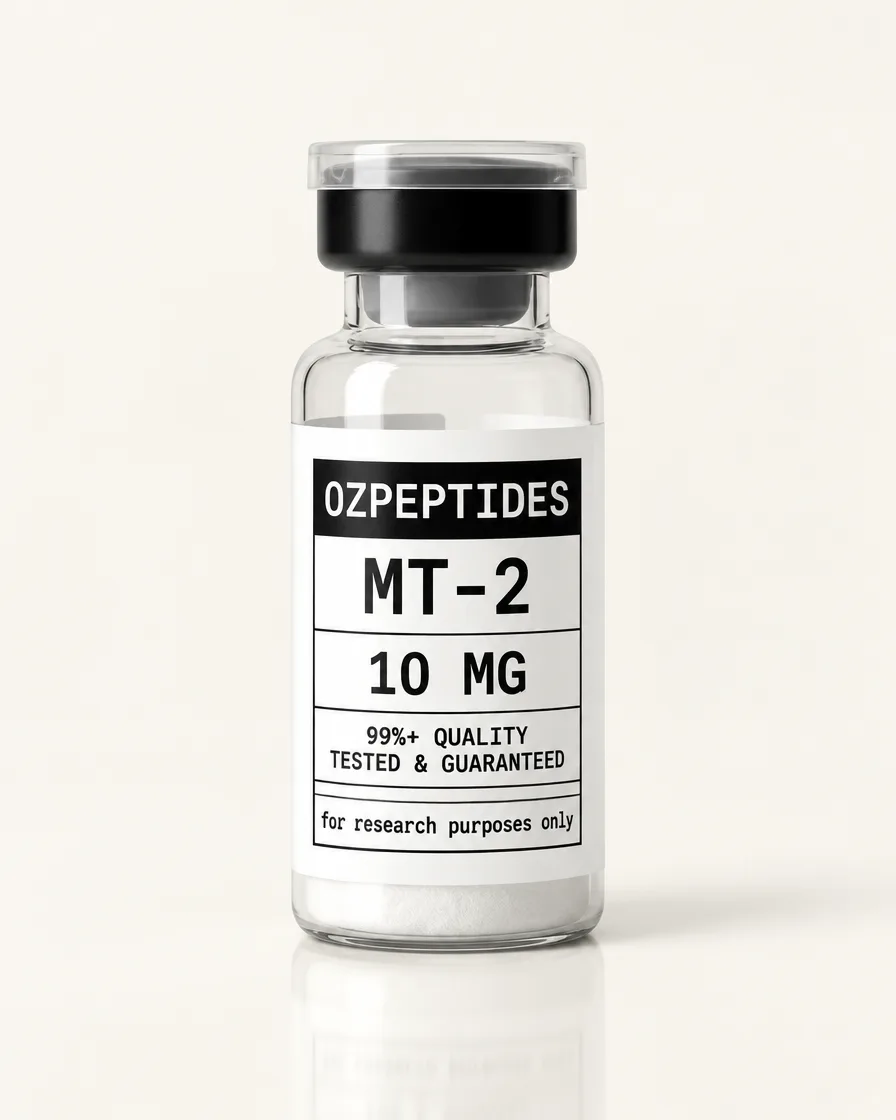
Light sensitivity matters more for the melanocortin peptides than for most of the catalogue, for the obvious reason. Otherwise the handling is standard: bacteriostatic water rather than sterile so the vial can be drawn from over weeks, diluent directed down the side, swirl rather than shake since foaming indicates denatured peptide, refrigerate once mixed. We stock MT-2 in 10MG vials.
How is research-grade MT-2 verified?
Identity by mass spectrometry, purity by HPLC, and heavy-metal screening, with the results recorded against the batch number on the vial.
For a compound this heavily counterfeited, identity confirmation is not a formality — it is the only thing that distinguishes a cyclised MT-2 from a linear impostor or from a relabelled sibling peptide. We make MT-2 in Blacktown, NSW, at ≥99% HPLC purity with 0 ppm heavy metals, and supply it for in-vitro and laboratory research only, to buyers aged 18 and over. It is not a medicine and is not registered in Australia.
Research-grade MT-2, made in Australia.
One of the most counterfeited peptides online, made and tested here instead: ≥99% HPLC purity, mass-spec identity, 0 ppm heavy metals.
Frequently asked
No. Unlike MT-1, which became afamelanotide, MT-2 never entered formal development. What exists is a case-report literature.
Injectable tanning products containing melanotan peptides are unapproved and unassessed, and changes to skin lesions can go unnoticed in people using a compound that alters pigmentation.
By mass spectrometry. Skipping the cyclisation step gives a peptide of similar mass and different behaviour that appearance and purity figures will not reveal.
Directly. PT-141 is an MC4R-active metabolite of MT-2, developed separately as bremelanotide.
Melanotan II — a cyclic alpha-MSH analogue that activates MC1R, MC3R and MC4R.
Its shortened, cyclised structure binds several melanocortin receptor subtypes rather than mainly MC1R.
MT-2 is available in 10MG.
- Dorr RT, et al. Increased eumelanin expression and tanning is induced by a superpotent melanotropin [Nle4-D-Phe7]-α-MSH in humans. Photochem Photobiol 2000;72:526–532.
This guide summarises published research for educational purposes. It is not medical advice. OzPeptides products are sold for research and laboratory use only, not for human consumption. 18+ only.