Key facts
What is epithalon?
Epithalon is a synthetic tetrapeptide developed as the defined active fragment of epithalamin, an extract of the pineal gland.
The work comes out of the St Petersburg Institute of Bioregulation and Gerontology, where Vladimir Khavinson's group spent decades on short peptides derived from tissue extracts. Epithalamin was the crude extract; epithalon is the four-residue sequence identified as carrying its activity. That lineage explains both the interest and the caution: the compound has a long research history, but one concentrated in a small number of related groups and often published outside the main international journals.
How does epithalon work?
Published work reports effects on telomerase expression and on melatonin rhythm, with a proposed mechanism involving direct interaction with DNA promoter regions.
The most-cited finding is induction of telomerase activity in human somatic cell culture, with telomere elongation reported over successive passages. A separate strand of work proposes that short peptides of this kind bind directly to specific DNA sequences and influence gene expression — a mechanism that is plausible in principle for a tetrapeptide but not broadly independently confirmed. Restoration of age-related changes in melatonin secretion is also reported.
What is epithalon studied for?
Ageing markers, telomerase activity, circadian and pineal function.
The published body includes cell culture work on telomerase, rodent lifespan studies, and long-running human observational work reported by the originating group. Independent replication of the headline findings is limited, which is the single most important thing to know when reading the literature. It is a compound worth studying, described honestly: interesting results, narrow provenance.
Is epithalon approved in Australia?
No. It is not registered anywhere as a medicine.
Epithalon is not registered in Australia. As a peptide with no approved human therapeutic use it also sits within the WADA S0 catch-all for athletes. OzPeptides supplies it for in-vitro and laboratory research only, 18+, not for human consumption.
How is research-grade epithalon quality verified?
HPLC purity and mass-spec identity per batch, with heavy metals screened.
A four-residue peptide is an easy synthesis, so a genuine batch should test very clean and there is little excuse for anything else. Because the compound is inexpensive to make, the risk in the market is not sophisticated adulteration but carelessness — wrong fill weights and untested material. Our batches are made and tested in Australia, ≥99% HPLC purity, 0 ppm heavy metals, results recorded against the batch on your vial.
Where does epithalon come from?
From Soviet and Russian research on the pineal gland. It is a synthetic tetrapeptide — Ala-Glu-Asp-Gly — based on epithalamin, a pineal extract studied by Vladimir Khavinson's group.
The lineage explains a great deal about the compound's evidence profile. Khavinson's group in St Petersburg spent decades on short peptides derived from tissue extracts, on the premise that specific peptides regulate the tissues they come from. Epithalamin was the pineal extract; epithalon is the synthetic tetrapeptide distilled from it. This is a research tradition that ran largely parallel to Western work, with its own journals, its own standards, and very little overlap — which is the honest framing for everything that follows.
What is the telomerase claim?
Published work from the originating group reports epithalon induces telomerase activity in human somatic cells in culture, extending replicative capacity.
Telomeres shorten with each cell division, and telomerase is the enzyme that rebuilds them — active in germ cells and stem cells, largely silent in somatic cells. A small peptide reactivating it would be a remarkable finding, which is precisely why independent replication matters and why its absence is the central problem. The claim traces largely to the group that developed the compound, published in venues with limited international indexing, and has not been reproduced at scale by unaffiliated laboratories. Telomerase activation is also not unambiguously desirable, since it is a hallmark of most cancers.
How strong is the epithalon evidence?
Weak by international standards. The volume of publication is substantial; independent replication outside the originating tradition is close to absent.
The distinction between volume and weight is the whole issue. There are many published papers, including reports of extended lifespan in mice and rats and long-running human observational work, and they come overwhelmingly from one research tradition. Peer review in venues that are not indexed internationally, without replication by unaffiliated groups, does not carry the evidential weight that the paper count suggests. Saying so is not a dismissal of the research; it is the accurate description of where the evidence stands.
What does the pineal gland have to do with it?
The pineal produces melatonin and regulates circadian rhythm, and its function declines with age — the observation the whole peptide bioregulator tradition grew from.
Age-related pineal decline is real and well documented, particularly the fall in nocturnal melatonin output. The Russian research tradition took that observation further than the international literature did, proposing that pineal peptides regulate ageing processes more broadly. That extension is where the evidence thins. The underlying observation about the gland is uncontroversial; the therapeutic framework built on it is not, and holding the two apart is useful when reading anything about this compound.
Is epithalon prohibited in sport?
It has no approval for human therapeutic use in any Western jurisdiction, which places it under the WADA S0 catch-all.
S0 covers pharmacological substances with no current approval by any governmental regulatory health authority for human therapeutic use and not addressed elsewhere on the Prohibited List. Epithalon has no such approval, and its Russian research standing does not change that. Athletes subject to anti-doping rules should treat it as prohibited at all times.
What is epithalon's status in Australia?
Not registered in Australia. It is supplied here for in-vitro and laboratory research only, to buyers aged 18 and over.
Epithalon has never been assessed for use in Australia, and there is no approved product containing it. That is the same position as most compounds in this catalogue, but it is worth stating plainly for a compound whose marketing sometimes implies a regulatory standing it does not have anywhere. Registration in Russia, where it exists, carries no weight in Australia — a drug approved in one jurisdiction is simply not approved in another.
How is epithalon stored and reconstituted?
Lyophilised and cold for storage; bacteriostatic water for reconstitution, refrigerated, with a practical window of weeks.
A tetrapeptide is about as robust as a peptide gets and epithalon dissolves readily with no special handling. The standard rules apply: bacteriostatic water rather than sterile for a multi-draw window, diluent directed down the side of the vial, swirl rather than shake since foaming indicates denatured peptide, and refrigerate and keep out of light once mixed.
What should be checked in an epithalon vial?
Identity by mass spectrometry and purity by HPLC. A four-residue peptide is trivially cheap to make well, so a genuine batch should test essentially clean.
That simplicity means a mediocre purity figure on epithalon says something about the supplier rather than about the chemistry. There is also little economic incentive to adulterate a compound this cheap to synthesise, which shifts the realistic failure mode toward underfilling — a vial containing a fraction of its stated weight, which passes purity testing without difficulty. We make epithalon in Blacktown, NSW, at ≥99% HPLC purity with 0 ppm heavy metals.
Research-grade epithalon, made in Australia.
A cheap peptide to make, which is exactly why testing it matters: ≥99% HPLC purity, confirmed identity, 0 ppm heavy metals, tested batch by batch.
Frequently asked
From Vladimir Khavinson's pineal peptide research in St Petersburg. It is a synthetic tetrapeptide based on the pineal extract epithalamin.
Not by unaffiliated laboratories at scale. The claim traces largely to the originating group, published in venues with limited international indexing.
No. It is not registered in Australia, is not a registered medicine anywhere, and is supplied for in-vitro and laboratory research only.
Not unambiguously. Telomerase reactivation is a hallmark of most cancers, which is part of why the claim warrants scrutiny rather than enthusiasm.
A synthetic tetrapeptide (Ala-Glu-Asp-Gly) derived from research on pineal gland extracts, studied for telomerase and ageing markers.
Telomerase induction and telomere elongation have been reported in cell culture. Independent replication is limited, and cell-culture results are not human outcomes.
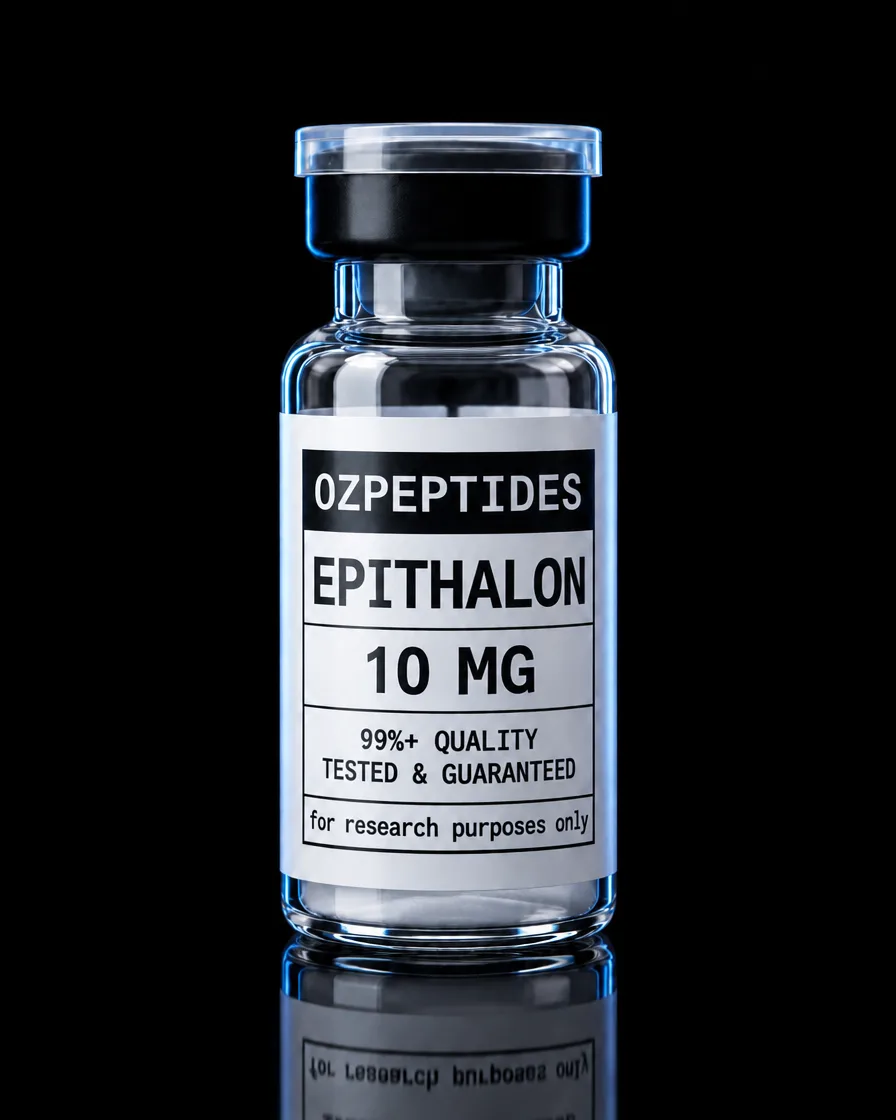
Epithalon is available in 10MG.
- Khavinson VKh, et al. Epithalon peptide induces telomerase activity and telomere elongation in human somatic cells. Bull Exp Biol Med 2003;135:590–592.
- Khavinson VKh, Morozov VG. Peptides of pineal gland and thymus prolong human life. Neuro Endocrinol Lett 2003;24:233–240.
This guide summarises published research for educational purposes. It is not medical advice. OzPeptides products are sold for research and laboratory use only, not for human consumption. 18+ only.