Key facts
What is NAD+?
NAD+ is a coenzyme that carries electrons in metabolic reactions and acts as a substrate for enzymes involved in repair and ageing signalling.
Every cell uses NAD+ constantly. In its oxidised form it accepts electrons during glycolysis and the citric acid cycle; in its reduced form, NADH, it hands them to the electron transport chain. Beyond that housekeeping role it is consumed as a substrate by sirtuins, PARPs and CD38 — enzymes involved in DNA repair, gene regulation and immune signalling — which is what turned a textbook metabolic cofactor into an ageing research subject.
Why do NAD+ levels matter?
Tissue NAD+ concentrations decline with age in published measurements, and the enzymes that consume it compete for a shrinking pool.
Consumption rises as it falls: PARP activity increases with accumulated DNA damage, and CD38 expression rises with age-related inflammation. Both consume NAD+, leaving less for sirtuins. That competition is the core of the "NAD+ decline" hypothesis. Whether raising NAD+ reverses any of it in humans is a genuinely open question — cell and rodent work is encouraging and human trial results are mixed and mostly short.
What is NAD+ studied for?
Ageing biology, mitochondrial function, DNA repair and metabolic research.
Much of the published human work uses precursors — nicotinamide riboside and nicotinamide mononucleotide — rather than NAD+ itself, because they are orally available where NAD+ largely is not. Trials have reported reliable increases in blood NAD+ levels with modest or unclear functional effects. Direct NAD+ administration is common in clinics and thin in the literature. A research guide should be clear that the popularity runs ahead of the evidence.
Is NAD+ approved in Australia?
NAD+ precursors are sold as supplements here; research-grade NAD+ in a vial is a different product and is not a medicine.
Nicotinamide and related compounds appear in listed supplements, which sit under a separate framework from registered medicines. Our lyophilised NAD+ is a research-grade laboratory reagent, not a supplement and not a medicine. It is supplied for in-vitro and laboratory research only, 18+, not for human consumption.
How is research-grade NAD+ quality verified?
Purity by HPLC, identity confirmed, and heavy-metal screening per batch.
NAD+ is a small molecule rather than a peptide, so the failure modes differ: degradation to nicotinamide and moisture uptake matter more than sequence errors, which is why it ships lyophilised and should be kept cold and dry. Every OzPeptides batch is tested in our Australian lab before release at ≥99% purity with 0 ppm heavy metals, with the results recorded against the batch on your vial.
What is NAD+ and why does it matter?
Nicotinamide adenine dinucleotide is a coenzyme present in every living cell, required for the redox reactions that produce cellular energy and as a substrate for sirtuins and PARPs.
NAD+ is not a peptide and sits apart from most of this catalogue. It has two distinct jobs. As a redox coenzyme it cycles between NAD+ and NADH, carrying electrons through glycolysis and the citric acid cycle — the chemistry that makes ATP. Separately, it is consumed as a substrate by enzymes including the sirtuins, involved in gene silencing and metabolic regulation, and PARPs, involved in DNA repair. That second role is the one the longevity research concerns, because those enzymes destroy NAD+ when they act rather than recycling it.
Does NAD+ actually decline with age?
Measured tissue NAD+ falls with age in multiple species including humans, and that observation is the foundation of the whole field.
The decline is reported across tissues and is one of the better-replicated findings in ageing biology. The interesting question is why. Proposed explanations include increased consumption by PARPs responding to accumulating DNA damage, increased activity of the NAD+-consuming enzyme CD38, and reduced salvage-pathway synthesis. These are not mutually exclusive, and which dominates matters, because a decline caused by increased consumption is a different problem from one caused by reduced synthesis — and precursor supplementation addresses only the second.
How does NAD+ differ from NMN and NR?
NMN and NR are precursors the cell converts to NAD+ through the salvage pathway. NAD+ itself is the finished coenzyme.
The distinction is practical as well as chemical. NAD+ is a large, charged molecule and its ability to cross cell membranes intact is questioned in the literature; precursors were developed partly because smaller molecules move more easily. Nicotinamide riboside and nicotinamide mononucleotide have their own human trials, generally showing they raise blood NAD+ levels, which is a pharmacokinetic result rather than a clinical one. Whether raising the measurable pool produces any functional benefit is the open question across all three forms.
How strong is the NAD+ evidence?
Strong on the biochemistry, thin on outcomes. That NAD+ is essential and declines with age is well established; that raising it produces benefits in humans is not.
This gap is the honest centre of the field. The mouse literature is genuinely striking in places — improvements in mitochondrial function, muscle performance and metabolic markers in aged animals. Human trials of precursors have mostly demonstrated that levels rise, with inconsistent effects on functional endpoints. Nothing here is approved for any indication. A field with excellent mechanistic grounding and unresolved clinical questions is a fair description, and it is more useful than either the enthusiasm or the dismissal it usually attracts.
What is the sirtuin connection?
Sirtuins are NAD+-dependent enzymes involved in gene silencing, metabolic regulation and stress responses. They consume NAD+ when they act, tying their activity to its availability.
That dependency is the mechanistic link between NAD+ and the ageing literature. If sirtuin activity requires NAD+, and NAD+ falls with age, then sirtuin activity may fall with it — a chain of reasoning that motivated much of the field. Each link is defensible and the chain as a whole has not been demonstrated in humans. The sirtuin literature itself has been contentious, with early lifespan findings in yeast and worms substantially revised on reanalysis, which is worth knowing before treating the connection as settled.
How is research-grade NAD+ stored and handled?
Lyophilised and cold for storage. NAD+ is less stable in solution than most peptides, particularly at neutral to alkaline pH, so mixed material has a shorter useful window.
This is one of the few compounds here where the solution-stability caveat is a real practical constraint rather than a formality. NAD+ hydrolyses over time in aqueous solution and the rate rises with pH and temperature, so cold, dark storage matters and the window is shorter than the several weeks typical of peptides. Bacteriostatic water is still the appropriate diluent for a multi-draw vial. Keep the powder cold and dry until it is needed rather than mixing early.
Is NAD+ prohibited in sport?
It is not on the WADA Prohibited List. NAD+ is an endogenous coenzyme present in every cell, and it is not a substance the list addresses.
That said, the list is revised annually and the route and source of any administered substance matter under anti-doping rules regardless of the substance itself. Research-grade material is not a medicine, is not supplied for human use, and carries no therapeutic use exemption pathway. Any athlete subject to the Code should check the current list directly rather than rely on a supplier summary.
What should be checked in an NAD+ vial?
Purity by HPLC and identity, with particular attention to degradation products given the compound's instability in solution.
NAD+ degrades to nicotinamide and ADP-ribose, and a batch that has been stored poorly or held in solution will show those products. That makes the analytical picture different from a peptide, where the question is mostly whether the right molecule is present at the stated purity. Fill weight matters as much as ever. We make NAD+ in Blacktown, NSW, at ≥99% HPLC purity with 0 ppm heavy metals, and supply it for in-vitro and laboratory research only.
Research-grade NAD+, made in Australia.
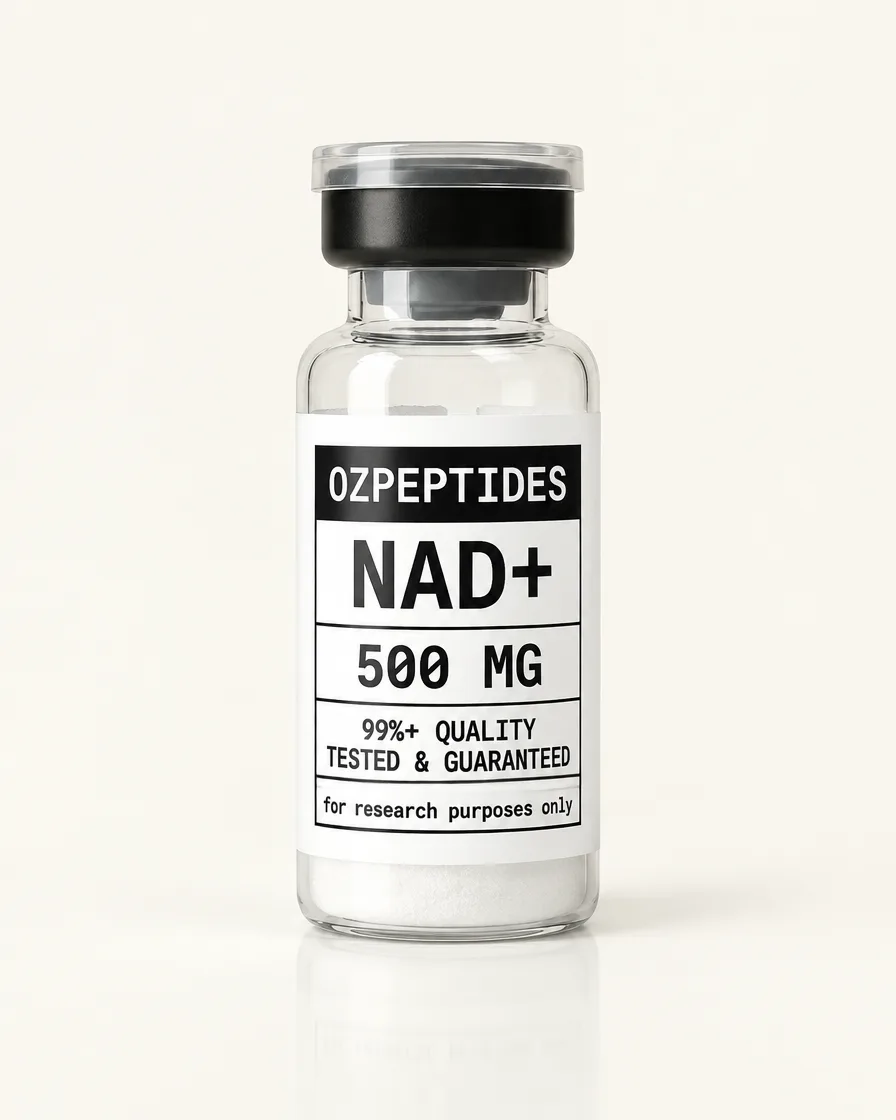
Lyophilised, tested and batch-certified here: ≥99% purity, 0 ppm heavy metals, in three strengths, with the results recorded against the batch on your vial.
Frequently asked
No. It is a coenzyme — nicotinamide adenine dinucleotide — present in every living cell, and it sits apart from the peptides in this catalogue.
NMN and NR are precursors the cell converts to NAD+ through the salvage pathway; NAD+ is the finished coenzyme. Most published human trials use the precursors because they are orally available.
Unresolved. Human trials of precursors reliably raise blood levels; effects on functional endpoints have been inconsistent, and the studies are mostly short.
It hydrolyses in aqueous solution, faster at higher pH and temperature, so mixed material has a shorter useful window than a typical peptide.
Measured tissue levels decline with age while the enzymes that consume it, such as PARPs and CD38, become more active.
NAD+ is available in 100MG, 500MG and 1000MG.
- Covarrubias AJ, et al. NAD+ metabolism and its roles in cellular processes during ageing. Nat Rev Mol Cell Biol 2021;22:119–141.
- Martens CR, et al. Chronic nicotinamide riboside supplementation is well-tolerated and elevates NAD+ in healthy middle-aged and older adults. Nat Commun 2018;9:1286.
This guide summarises published research for educational purposes. It is not medical advice. OzPeptides products are sold for research and laboratory use only, not for human consumption. 18+ only.