Key facts
What is glutathione?
Glutathione is a three-amino-acid peptide made in every human cell, present at millimolar concentrations, and central to redox balance.
Its structure has one unusual feature: the bond between glutamate and cysteine is a gamma-peptide bond, formed through the glutamate side chain rather than the usual backbone. That protects it from most peptidases and is why a molecule this small survives inside the cell. The reactive part is the cysteine thiol, which is what actually does the antioxidant work.
How does glutathione work?
It donates electrons from its thiol group to neutralise reactive species, cycling between reduced (GSH) and oxidised (GSSG) forms.
The GSH/GSSG ratio is one of the standard measures of a cell's redox state, and glutathione reductase regenerates the reduced form using NADPH. Beyond direct scavenging, glutathione is a substrate for glutathione peroxidases and S-transferases, which is how it participates in detoxification of peroxides and xenobiotics in the liver. In skin research it is also studied for effects on melanogenesis.
What is glutathione studied for?
Oxidative stress, liver detoxification pathways, and skin pigmentation research.
The clinical literature concentrates on conditions with documented glutathione depletion, and on N-acetylcysteine as a precursor — NAC is the established route for raising it. Oral glutathione itself is poorly absorbed intact, which is why the compound turns up so often in injectable and IV form and why claims about oral products deserve scepticism. Skin-lightening research exists but is of variable quality.
Is glutathione approved in Australia?
It is available in supplement form; injectable glutathione is not an approved medicine here.
Injectable glutathione products marketed for skin lightening are not registered medicines in Australia. Our research-grade material is a laboratory reagent, not a supplement or a medicine, and is supplied for in-vitro and laboratory research only, 18+, not for human consumption.
How is research-grade glutathione quality verified?
HPLC purity, identity confirmation and heavy-metal screening, batch by batch.
Glutathione oxidises readily — that is its job — so the meaningful quality question is how much of a batch is still in the reduced form when it reaches you. It ships lyophilised and should be kept cold, dry and dark, and reconstituted only when needed. Every OzPeptides batch is tested here at ≥99% purity with 0 ppm heavy metals and the results recorded against the batch.
What is glutathione?
A tripeptide of glutamate, cysteine and glycine, and the most abundant antioxidant made inside human cells — present at millimolar concentrations in most tissues.
Glutathione is not an exotic research compound; it is fundamental cell biology. It is synthesised inside cells in two ATP-dependent steps and exists in a reduced form, GSH, and an oxidised dimer, GSSG. The ratio between them is one of the standard measures of a cell's oxidative state, which is why glutathione appears in an enormous range of research contexts. The cysteine residue does the work: its thiol group is what donates electrons, and cysteine availability is generally what limits how much a cell can make.
What does glutathione actually do?
Three main things: it neutralises reactive oxygen species, it is a cofactor for glutathione peroxidases and transferases, and it conjugates toxins for excretion.
The detoxification role is the one most often understated. Phase II metabolism in the liver conjugates glutathione to electrophilic compounds, making them water-soluble and excretable — the mechanism by which paracetamol overdose depletes glutathione and causes liver injury, and the reason N-acetylcysteine is the antidote. It is also the cofactor for the glutathione peroxidases, which reduce hydrogen peroxide and lipid peroxides, and it maintains other antioxidants including vitamins C and E in their reduced forms.
Why is oral glutathione considered poorly absorbed?
Because it is a tripeptide and the gut hydrolyses it into its constituent amino acids, which the body then has to resynthesise into glutathione inside cells.
This is the central practical problem with glutathione and the reason alternative routes are studied at all. Orally administered glutathione is largely broken down before absorption, so what reaches circulation is mostly free amino acids. Some studies report modest increases in body stores with sustained oral administration, and liposomal formulations have been explored to protect the molecule through the gut. The competing approach is to supply cysteine — the rate-limiting precursor — instead, which is the rationale behind N-acetylcysteine.
What is the evidence for supplemental glutathione?
Mixed and mostly small. Depletion is unambiguously harmful; whether supplementing above normal levels helps a healthy system is much less clear.
Those two questions get conflated constantly. That glutathione depletion causes damage is established beyond argument — paracetamol hepatotoxicity is the textbook case. That raising glutathione in someone whose levels are normal produces a benefit is a separate claim with much weaker support, and the trials that exist are small, heterogeneous and often use surrogate markers. Skin-lightening claims in particular, which drive much of the commercial interest, rest on a thin and largely low-quality literature.
Is glutathione prohibited in sport?
It is not on the WADA Prohibited List as a substance, but intravenous administration above the permitted volume is prohibited by method.
This is a distinction worth getting right, because it catches people out. WADA M2 prohibits intravenous infusions and injections above a stated volume within a stated period, regardless of what is being infused. A substance can be entirely permitted while the route used to administer it is not. Athletes subject to the Code should read the current list on both counts, and treat research-grade material — which is not a medicine and carries no exemption pathway — accordingly.
How is glutathione stored and reconstituted?
Lyophilised and cold. Glutathione oxidises readily in solution, so mixed material has a short useful window and air exposure matters.
The reduced form is the active one, and it converts to the oxidised dimer on exposure to air and light — which is why the compound is supplied lyophilised and why a reconstituted vial should be kept cold, dark and not held for long. This is a more genuine constraint than the equivalent caution on most peptides. Keep the powder cold and dry until needed rather than mixing early, and expect a shorter window than the several weeks typical elsewhere in the catalogue.
How does glutathione compare with N-acetylcysteine?
NAC supplies cysteine, the rate-limiting precursor, and lets the cell make its own glutathione. It is an approved medicine for paracetamol overdose.
The comparison is genuinely informative. NAC has the stronger pharmacological position: it is absorbed, it is a registered medicine with an established clinical use, and it addresses the actual bottleneck in glutathione synthesis rather than trying to deliver a tripeptide intact. Direct glutathione administration bypasses synthesis entirely, which is either an advantage or a redundancy depending on whether synthesis is the limiting step. Both approaches appear in the literature and neither has settled the question.
What should be checked in a glutathione vial?
Purity by HPLC, the reduced-to-oxidised ratio, and fill weight. The oxidised form is not the active one.
A certificate reporting purity without distinguishing GSH from GSSG is leaving out the thing that matters, since a fully oxidised batch can be chemically pure and functionally useless. That is a failure mode specific to this compound and it is invisible without the right assay. Fill weight matters as much as for any product sold without a regulator checking it. We make glutathione in Blacktown, NSW, at ≥99% HPLC purity with 0 ppm heavy metals.
Research-grade glutathione, made in Australia.
Lyophilised and tested here so it reaches you reduced, not oxidised: ≥99% purity, 0 ppm heavy metals, tested batch by batch.
Frequently asked
Yes — a tripeptide of glutamate, cysteine and glycine, and the most abundant antioxidant made inside human cells.
The gut hydrolyses it into its constituent amino acids, which the body must then resynthesise into glutathione inside cells. Precursors such as N-acetylcysteine are the better-established route for raising cellular levels.
Not as a substance, but WADA M2 prohibits intravenous infusions above a stated volume regardless of what is infused.
GSH is the reduced, active form; GSSG is the oxidised dimer. A certificate that does not distinguish them is leaving out what matters.
A tripeptide of glutamate, cysteine and glycine that acts as the main intracellular antioxidant in human cells.
The glutamate-cysteine bond is a gamma-peptide bond, which protects it from most peptidases.
No. Injectable glutathione products marketed for skin lightening are not registered medicines in Australia.
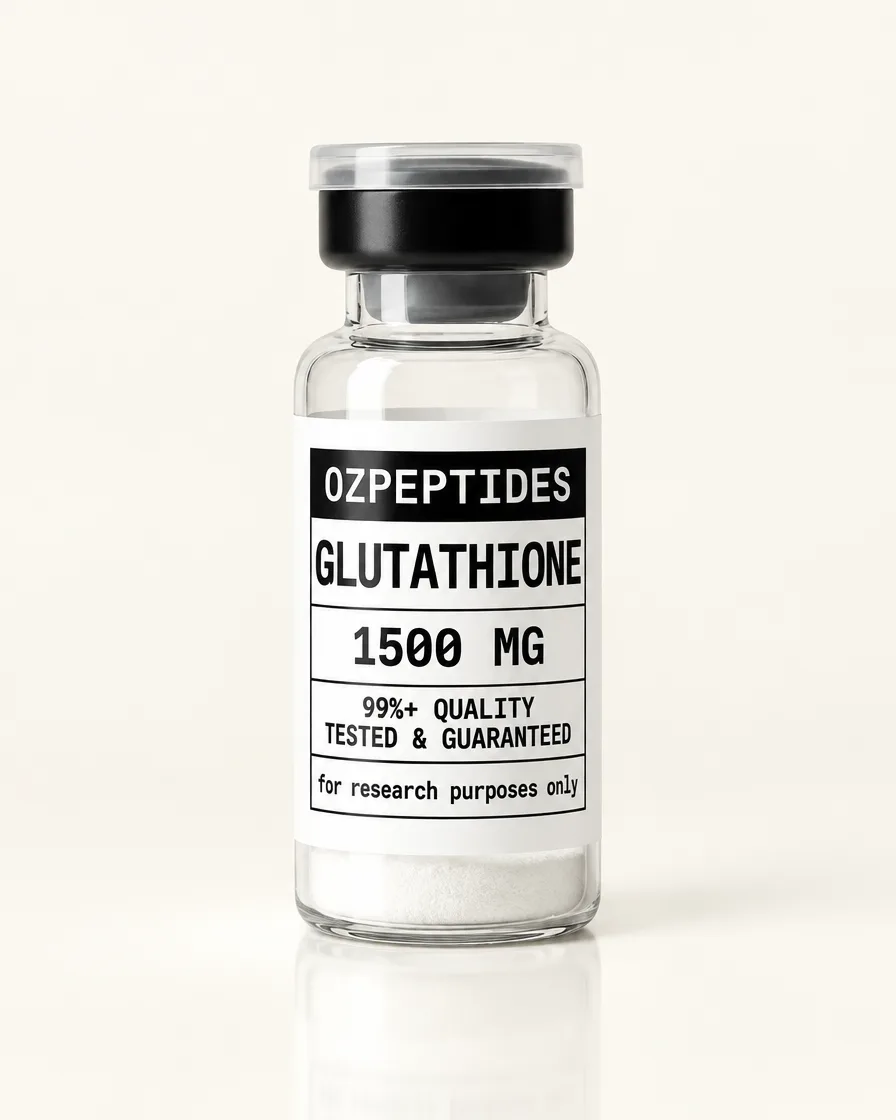
Glutathione is available in 600MG and 1500MG.
- Forman HJ, Zhang H, Rinna A. Glutathione: overview of its protective roles, measurement, and biosynthesis. Mol Aspects Med 2009;30:1–12.
- Allen J, Bradley RD. Effects of oral glutathione supplementation on systemic oxidative stress biomarkers in human volunteers. J Altern Complement Med 2011;17:827–833.
This guide summarises published research for educational purposes. It is not medical advice. OzPeptides products are sold for research and laboratory use only, not for human consumption. 18+ only.