Key facts
What is ipamorelin?
Ipamorelin is a short synthetic peptide developed in the 1990s as a selective growth hormone secretagogue.
It came out of work at Novo Nordisk looking for compounds that release GH without the collateral hormonal effects of the earlier growth hormone-releasing peptides. The original paper describes it as the first selective GHS, and that framing has stuck. At five residues it is also one of the simplest peptides in our range to synthesise and to handle.
How does ipamorelin work?
It activates GHS-R1a, the ghrelin receptor, prompting GH release and reducing somatostatin's inhibitory signal.
The ghrelin receptor route is separate from the GHRH receptor, which is why the two classes are studied together. What sets ipamorelin apart within its class is what it does not do: published comparisons report GH release comparable to GHRP-6 without the marked ACTH, cortisol and prolactin increases, and without the pronounced appetite stimulation that makes GHRP-6 distinctive.
What is ipamorelin studied for?
Growth hormone secretion research, bone density models, and postoperative ileus research.
The foundational work is the 1998 characterisation of its selectivity. Later published research includes rodent bone-density models and a clinical programme in postoperative ileus, where it was investigated for effects on gastrointestinal motility via the ghrelin receptor — a reminder that ghrelin signalling is not only about growth hormone. That programme did not lead to approval.
Is ipamorelin approved in Australia?
No. It is not registered and is prohibited in sport.
Ipamorelin is not registered in Australia, and GH secretagogues are prohibited by WADA under S2 at all times. OzPeptides supplies ipamorelin for in-vitro and laboratory research only, 18+, not for human consumption.
How is research-grade ipamorelin quality verified?
HPLC purity, mass-spec identity and heavy-metal screening on every batch.
A pentapeptide is an easy synthesis, so a genuine batch should test very clean — and because it is cheap to make, under-filling rather than impurity is the common commercial shortcut. That is a weighing problem, not a chemistry one, and it is why our batch record states the fill. Every batch is made and tested here at ≥99% HPLC purity with 0 ppm heavy metals.
What makes ipamorelin different from the older GHRPs?
Selectivity. It was developed at Novo Nordisk to release growth hormone without the marked ACTH, cortisol, prolactin and appetite response that GHRP-6 and GHRP-2 produce.
The 1998 characterisation describes it as the first selective growth hormone secretagogue, and that claim is the whole reason ipamorelin rather than GHRP-6 became the usual partner for a GHRH analogue. The older GHRPs activate the same receptor and bring collateral effects with them — GHRP-6's appetite stimulation is unsurprising given it acts on the receptor ghrelin uses. In a study where cortisol or prolactin are variables rather than the subject, that collateral activity is a confound rather than a side effect.
What receptor does ipamorelin act on?
GHS-R1a, the ghrelin receptor. It both prompts growth hormone release and reduces somatostatin tone — pressing the accelerator while easing the brake.
The growth hormone-releasing peptides came out of Cyril Bowers' work in the 1980s and 90s, before the ghrelin receptor had been identified: their activity implied a receptor nobody had found, which is how the field arrived at ghrelin in 1999. That history explains the class name and the odd position of these compounds, which were pharmacologically characterised before their target was known. Acting on a different receptor from GHRH is what makes combined use mechanistically coherent.
How does the growth hormone axis work?
GHRH from the hypothalamus prompts release from the pituitary, somatostatin restrains it, and IGF-1 from the liver feeds back to restrain it further.
Understanding the loop is what separates a secretagogue from growth hormone itself. Because a secretagogue acts on the pituitary rather than replacing the hormone, the somatostatin brake and the IGF-1 feedback stay intact, and release stays pulsatile. That matters: sustained elevation downregulates receptors and is associated with the adverse-effect profile of exogenous growth hormone, while pulsatility is the physiological pattern. It also caps what any secretagogue can do — the pituitary can only release what it holds, so the ceiling is the gland's own capacity rather than the amount administered.
What clinical research exists on ipamorelin?
A clinical programme in postoperative ileus, which did not lead to approval, plus preclinical work including rodent bone-density models.
That is more than most compounds in this catalogue have and less than an approval. The ileus programme was a serious attempt at a specific indication — gut motility after surgery, a plausible target given ghrelin receptor biology — and it stopped short of registration. The bone-density work in rodents is the other frequently cited line. Neither establishes anything about the compound outside those contexts, and ipamorelin has no approval in any jurisdiction.
Why is ipamorelin paired with CJC-1295?
Because they act on different arms of the same system, and class-level synergy between GHRH and growth hormone-releasing peptides is documented.
Bowers and colleagues reported synergy between the two classes in 1990, and combined administration is used clinically to test pituitary growth hormone reserve. That is genuine class-level evidence. What does not exist is a trial of the specific commercial blend, so the reasoning for the pairing is mechanism and class data rather than a study of the vial — a distinction the market routinely collapses, and the one place where claims about this combination most often overreach.
Is ipamorelin prohibited in sport?
Yes. WADA S2 covers growth hormone secretagogues including ghrelin receptor agonists, prohibited at all times, in and out of competition.
The class is named on the Prohibited List and anti-doping laboratories screen specifically for growth hormone secretagogues. Ipamorelin has no approval for human therapeutic use anywhere, which would engage S0 independently. Any athlete subject to the World Anti-Doping Code should treat it as prohibited without qualification.
How is ipamorelin stored and reconstituted?
Lyophilised and cold for storage; bacteriostatic water for reconstitution, refrigerated, with a practical window of weeks.
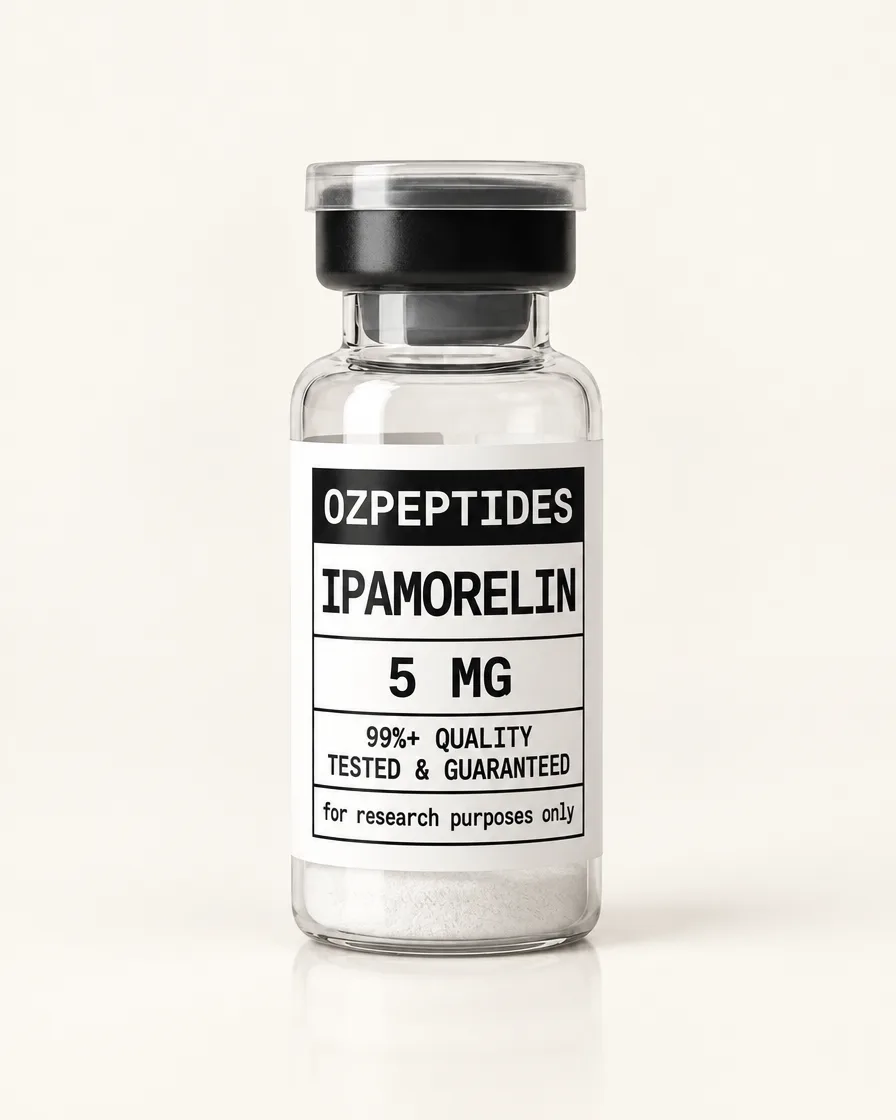
Ipamorelin is a pentapeptide and robust, dissolving readily. The standard rules still apply: bacteriostatic water rather than sterile for a multi-draw window, diluent directed down the side of the vial, swirl rather than shake, refrigerate and keep out of light once mixed. We stock ipamorelin in 5MG and 10MG vials; 5MG in 2ML gives 2.5MG/ML, so a 0.1ML draw is 250mcg.
What should be checked in an ipamorelin vial?
Identity by mass spectrometry, purity by HPLC and fill weight. Ipamorelin and the older GHRPs are sold alongside each other and confused.
Substituting GHRP-6 or GHRP-2 for ipamorelin is a meaningful swap — the whole point of ipamorelin is that it does not carry their cortisol, prolactin and appetite effects, so a mislabelled vial produces a different pharmacological profile while testing clean on purity. Mass spectrometry resolves it. We make ipamorelin in Blacktown, NSW, at ≥99% HPLC purity with 0 ppm heavy metals.
Research-grade ipamorelin, made in Australia.
Cheap to make, which is why the fill weight and the testing matter: ≥99% HPLC purity, mass-spec identity, 0 ppm heavy metals, tested batch by batch.
Frequently asked
It releases growth hormone without the marked ACTH, cortisol, prolactin and appetite response that GHRP-6 and GHRP-2 produce.
GHS-R1a, the ghrelin receptor. It prompts release and also reduces somatostatin tone.
Yes, in postoperative ileus. The programme did not lead to approval, and ipamorelin is not registered anywhere.
Yes. WADA S2 covers ghrelin receptor agonists as growth hormone secretagogues, prohibited at all times.
A selective five-amino-acid growth hormone secretagogue acting on the ghrelin receptor GHS-R1a.
They act on separate receptors, and the combination is studied for a larger combined GH response.
Ipamorelin is available in 5MG and 10MG.
- Raun K, et al. Ipamorelin, the first selective growth hormone secretagogue. Eur J Endocrinol 1998;139:552–561.
- Beck DE, et al. Efficacy of ipamorelin for postoperative ileus. Am J Surg 2014;208:551–558.
This guide summarises published research for educational purposes. It is not medical advice. OzPeptides products are sold for research and laboratory use only, not for human consumption. 18+ only.