Key facts
What is GHRP-2?
GHRP-2, also called pralmorelin, is a six-amino-acid synthetic secretagogue from the generation of compounds that preceded ipamorelin.
The GHRP series came out of Cyril Bowers' work in the 1980s and 90s on peptides that released growth hormone through a pathway distinct from GHRH — before the ghrelin receptor itself had been identified. GHRP-2 is the more potent GH releaser of the pair we stock, and in Japan it has been used as a diagnostic agent for testing pituitary GH secretion.
How does GHRP-2 work?
It activates GHS-R1a and also reduces somatostatin tone, releasing GH — with some effect on ACTH and prolactin.
The mechanism is the same receptor ipamorelin uses; the difference is selectivity. Published work reports GHRP-2 raises cortisol and prolactin alongside GH, which is a confound in research designs where those hormones matter. Its appetite effect is present but weaker than GHRP-6's. Choosing between the three GHS compounds is mostly about which side effects a given study can tolerate.
What is GHRP-2 studied for?
Pituitary GH reserve testing, GH secretion physiology, and appetite research.
Its clearest established use is diagnostic: assessing whether a pituitary can release GH when stimulated. Research also covers combined administration with GHRH analogues, where the synergy between the two pathways is well documented, and ghrelin-system work on appetite and gastric motility.
Is GHRP-2 approved in Australia?
No. It is prohibited in sport and is not registered here.
GHRP-2 is not registered in Australia. It is named within the WADA S2 category of growth hormone secretagogues, prohibited at all times, and it is one of the compounds anti-doping laboratories specifically screen for. OzPeptides supplies it for in-vitro and laboratory research only, 18+, not for human consumption.
How is research-grade GHRP-2 quality verified?
HPLC purity, mass-spec identity, heavy-metal screening per batch.
The GHRP compounds are short, similar in size and easily confused with one another on a label — GHRP-2 and GHRP-6 differ by two residues. Mass spectrometry distinguishes them without ambiguity, which is the point of confirming identity rather than assuming it. Made and tested in our Australian lab at ≥99% HPLC purity, 0 ppm heavy metals.
Where did the GHRPs come from?
From Cyril Bowers' work in the 1980s and 90s, before the ghrelin receptor had been identified. Their activity implied a receptor nobody had found.
That is the odd and genuinely interesting history of this class: a set of peptides were characterised pharmacologically, shown to release growth hormone through a pathway distinct from GHRH, and used for years before anyone knew what they bound to. The search for the endogenous ligand of that unknown receptor is how the field arrived at ghrelin in 1999 — found in the stomach, not the brain, which surprised everyone. The GHRPs are therefore a case of the tool preceding the biology.
How selective is GHRP-2?
Less selective than ipamorelin. It raises cortisol and prolactin alongside growth hormone, though generally less markedly than GHRP-6 raises appetite.
All the growth hormone-releasing peptides act on GHS-R1a, the ghrelin receptor, and collateral endocrine effects come with that territory. GHRP-2 sits between GHRP-6 and ipamorelin on this axis: appetite stimulation is reported but less pronounced than with GHRP-6, while cortisol and prolactin elevation is documented. For any study where those hormones are variables rather than the subject, that is a confound to design around, and it is the specific reason ipamorelin exists.
How does the growth hormone axis work?
GHRH from the hypothalamus prompts release from the pituitary, somatostatin restrains it, and IGF-1 from the liver feeds back to restrain it further.
Understanding the loop is what separates a secretagogue from growth hormone itself. A secretagogue acts on the pituitary rather than replacing the hormone, so the somatostatin brake and the IGF-1 feedback stay intact and release stays pulsatile. That matters, because sustained elevation downregulates receptors and is associated with the adverse-effect profile of exogenous growth hormone. It also caps what a secretagogue can do: the pituitary can only release what it holds, so the ceiling is the gland's own capacity rather than the amount administered.
Has GHRP-2 been used clinically?
Yes, as a diagnostic agent. It has been used to test pituitary growth hormone reserve, and in Japan it was developed for growth hormone deficiency diagnosis.
Diagnostic use is a real and underappreciated part of this class's history. Testing whether a pituitary can release growth hormone requires provoking it, and a secretagogue does that more conveniently than the older insulin tolerance test. GHRP-2 reached that application in some jurisdictions. It is not the same as approval for therapeutic use, and it does not translate into any claim about research-grade material, but it does mean the compound has been characterised in humans more thoroughly than most peptides here.
Is GHRP-2 prohibited in sport?
Yes. WADA S2 covers growth hormone secretagogues including ghrelin receptor agonists, prohibited at all times, in and out of competition.
GHRP-2 is specifically named among the growth hormone-releasing peptides on the Prohibited List, and anti-doping laboratories have established detection methods for this class. It has been detected in athlete samples and has featured in sanctions. Any athlete subject to the World Anti-Doping Code should treat it as prohibited without qualification.
How does GHRP-2 compare with GHRP-6 and ipamorelin?
Three compounds on one receptor, differing in collateral effects. GHRP-6 stimulates appetite markedly, GHRP-2 less so, ipamorelin was designed to avoid both.
The practical distinction between them is not potency at the receptor but what else they do while acting on it. Ipamorelin's 1998 characterisation describes it as the first selective growth hormone secretagogue, releasing growth hormone without the marked ACTH, cortisol, prolactin and appetite response of the earlier compounds. That is why ipamorelin became the standard partner for a GHRH analogue, and why GHRP-2 and GHRP-6 remain more useful as tools for studying the ghrelin receptor itself.
How is GHRP-2 stored and reconstituted?
Lyophilised and cold for storage; bacteriostatic water for reconstitution, refrigerated, with a practical window of weeks.
A hexapeptide is robust and dissolves readily. The standard handling still applies: bacteriostatic water rather than sterile for a multi-draw window, diluent directed down the side of the vial, swirl rather than shake since foaming indicates denatured peptide, and refrigerate and keep out of light once mixed. A 10MG vial in 2ML gives 5MG/ML, so a 0.1ML draw is 500mcg.
What should be checked in a GHRP-2 vial?
Identity by mass spectrometry, purity by HPLC and fill weight. The GHRPs are sold alongside each other and are easily substituted.
GHRP-2, GHRP-6 and ipamorelin have different sequences and different masses but similar prices and similar appearance, and a purity assay cannot tell them apart. Substituting one for another changes the collateral hormone profile entirely while testing clean, which is a subtle failure that produces results about a different compound. We make GHRP-2 in Blacktown, NSW, at ≥99% HPLC purity with 0 ppm heavy metals.
What is stocked, and how the arithmetic works
GHRP-2 is supplied in 10MG vials. Reconstituted in 2ML of bacteriostatic water that is 5MG/ML, so a 0.1ML draw on an insulin syringe is 500mcg.
The arithmetic is worth doing explicitly rather than by habit, because the same draw volume delivers different amounts depending on how much diluent went in — the single most common error when moving between vials. Adding 1ML instead of 2ML to the same 10MG vial gives 10MG/ML and doubles what that draw contains. Neither is wrong; what matters is that the concentration is known rather than assumed. Adding more bacteriostatic water does not make the peptide weaker in any chemical sense, it simply spreads the same quantity through a larger volume, which is a distinction that trips people up regularly. The reconstitution calculator is pre-filled per SKU so the figures come from the vial in hand rather than a generic worked example, and it reports both concentration and units on a standard insulin syringe.
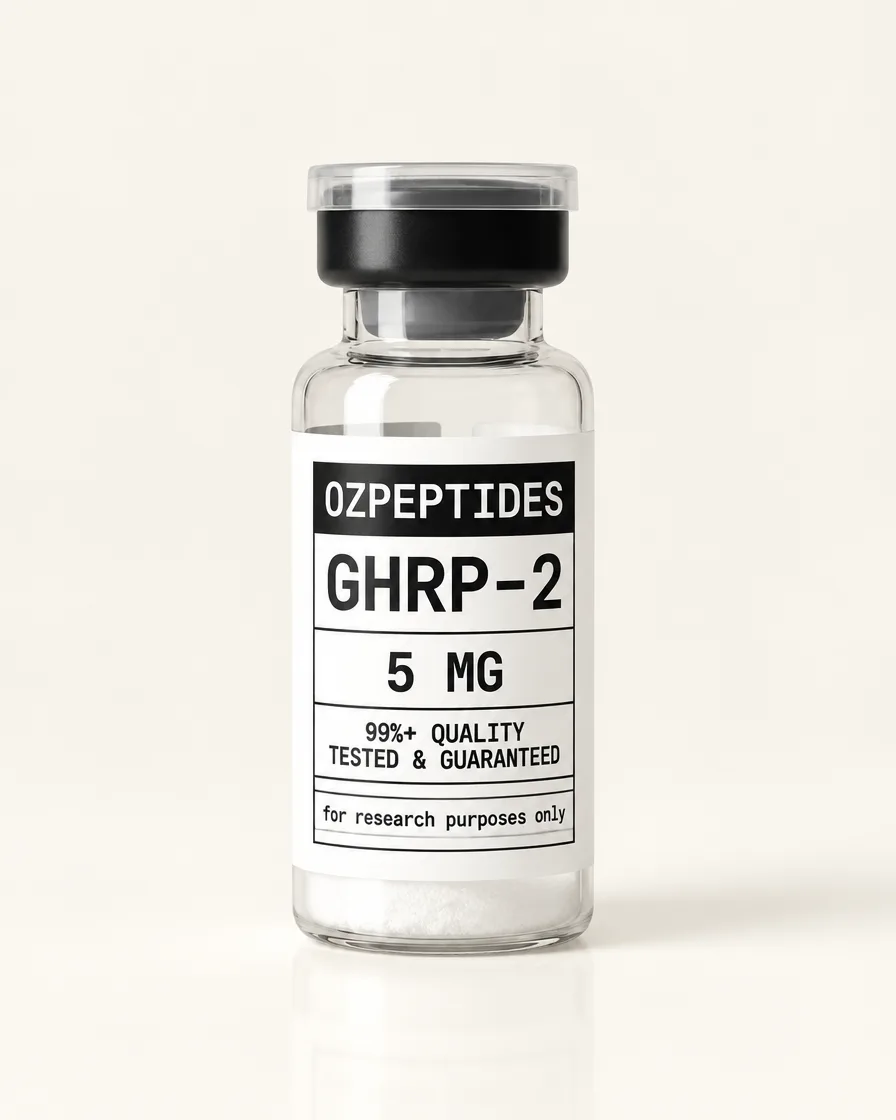
Research-grade GHRP-2, made in Australia.
Two residues separate it from GHRP-6, so we confirm which you have: mass-spec identity, ≥99% HPLC purity, 0 ppm heavy metals.
Frequently asked
No. It spreads the same quantity of peptide through a larger volume, so the concentration falls while the total stays the same.
Less so than ipamorelin. It raises cortisol and prolactin alongside growth hormone, and stimulates appetite, though less markedly than GHRP-6.
Yes, as a diagnostic agent for testing pituitary growth hormone reserve, and it was developed for that purpose in some jurisdictions.
Yes. WADA S2 names the growth hormone-releasing peptides, prohibited at all times, and laboratories detect them.
GHS-R1a, the ghrelin receptor — identified in 1999, years after the peptides themselves were characterised.
A synthetic hexapeptide growth hormone secretagogue acting on the ghrelin receptor, also known as pralmorelin.
GHRP-2 is the more potent GH releaser; GHRP-6 has the stronger appetite effect.
GHRP-2 is available in 5MG, 10MG and 15MG.
- Bowers CY. Growth hormone-releasing peptide (GHRP). Cell Mol Life Sci 1998;54:1316–1329.
- Chihara K, et al. Efficacy and safety of growth hormone-releasing peptide-2 (GHRP-2) as a GH stimulation test. Clin Endocrinol 2007;67:848–854.
This guide summarises published research for educational purposes. It is not medical advice. OzPeptides products are sold for research and laboratory use only, not for human consumption. 18+ only.