Key facts
What is GHRP-6?
GHRP-6 is a six-amino-acid synthetic peptide, the earliest of the growth hormone-releasing peptides to be widely studied.
Its scientific significance goes beyond what it does: because GHRP-6 released GH through a receptor that was clearly not the GHRH receptor, its activity implied an unknown endogenous ligand. That receptor was cloned in 1996 and named the growth hormone secretagogue receptor; ghrelin, the natural hormone that binds it, was identified in 1999. GHRP-6 is how the field got there.
How does GHRP-6 work?
It activates GHS-R1a, releasing GH and — through the same receptor — strongly stimulating appetite.
Ghrelin is the hunger hormone, so a ghrelin receptor agonist stimulating appetite is not a side effect in the usual sense; it is the same signal. GHRP-6 produces that effect more markedly than GHRP-2 or ipamorelin, which makes it a useful tool in appetite and feeding research and a poor choice where appetite is a confound. Cortisol and prolactin increases are also reported.
What is GHRP-6 studied for?
Ghrelin receptor pharmacology, appetite and feeding research, and GH secretion.
Beyond its historical role, GHRP-6 appears in feeding-behaviour research and in cardiovascular work — published studies have looked at GHS-R expression in the heart and at cytoprotective effects in ischaemia models, which is an active line independent of growth hormone. Cuban research groups in particular have published on that direction.
Is GHRP-6 approved in Australia?
No. It is not registered and is prohibited in sport.
GHRP-6 is not registered in Australia and falls under WADA S2 as a growth hormone secretagogue, prohibited at all times. OzPeptides supplies it for in-vitro and laboratory research only, 18+, not for human consumption.
How is research-grade GHRP-6 quality verified?
Purity by HPLC, identity by mass spectrometry, heavy metals screened.
Like the other GHRPs it is a simple, inexpensive synthesis, so quality problems in the market are about honesty rather than difficulty: mislabelling between GHRP compounds, and light fills. Identity confirmation and a stated fill weight address both. Made and tested in our Australian lab at ≥99% HPLC purity with 0 ppm heavy metals.
Where did the GHRPs come from?
From Cyril Bowers' work in the 1980s and 90s, before the ghrelin receptor had been identified. Their activity implied a receptor nobody had found.
That is the odd and genuinely interesting history of this class: a set of peptides were characterised pharmacologically, shown to release growth hormone through a pathway distinct from GHRH, and used for years before anyone knew what they bound to. The search for the endogenous ligand of that unknown receptor is how the field arrived at ghrelin in 1999 — found in the stomach, not the brain, which surprised everyone. The GHRPs are therefore a case of the tool preceding the biology.
Why does GHRP-6 stimulate appetite so markedly?
Because it activates GHS-R1a, the receptor ghrelin uses — and ghrelin is the hormone that signals hunger.
The appetite effect is not a side effect in any meaningful sense; it is what the receptor does. Ghrelin is secreted by the stomach, rises before meals, and acts on the hypothalamus to drive food intake. A synthetic agonist at the same receptor produces the same signal, and GHRP-6 does so more strongly than the later compounds in its class. That makes it a useful tool for studying ghrelin receptor biology and a poor one for isolating growth hormone effects, which is the whole reason more selective compounds were developed.
How does the growth hormone axis work?
GHRH from the hypothalamus prompts release from the pituitary, somatostatin restrains it, and IGF-1 from the liver feeds back to restrain it further.
Understanding the loop is what separates a secretagogue from growth hormone itself. A secretagogue acts on the pituitary rather than replacing the hormone, so the somatostatin brake and the IGF-1 feedback stay intact and release stays pulsatile. That matters, because sustained elevation downregulates receptors and is associated with the adverse-effect profile of exogenous growth hormone. It also caps what a secretagogue can do: the pituitary can only release what it holds, so the ceiling is the gland's own capacity rather than the amount administered.
What else does GHRP-6 raise?
Cortisol and prolactin, alongside growth hormone. Those elevations are documented and are the reason the compound is a confounded tool for growth hormone research.
ACTH and cortisol elevation with the early GHRPs was reported in the original pharmacological work and is not disputed. In a study where the growth hormone axis is the subject, a compound that simultaneously moves the adrenal axis and prolactin makes the result hard to attribute. Ipamorelin was developed at Novo Nordisk specifically to remove that confound, and its 1998 characterisation describes release comparable to GHRP-6 without the marked collateral response.
Is GHRP-6 prohibited in sport?
Yes. WADA S2 covers growth hormone secretagogues including the growth hormone-releasing peptides, prohibited at all times.
GHRP-6 is named among the growth hormone-releasing peptides on the Prohibited List and anti-doping laboratories have established detection methods for the class. It has appeared in sanctions. Any athlete subject to the World Anti-Doping Code should treat it as prohibited without qualification, in and out of competition.
What is GHRP-6 actually useful for in research?
Studying ghrelin receptor biology, where its lack of selectivity is the point rather than a problem.
A compound that engages the ghrelin receptor and produces the full downstream response — growth hormone, appetite, cortisol, prolactin — is a reasonable instrument for asking what that receptor does. Used against ipamorelin as a selective comparator, the pair can separate effects that require the full response from those that do not. That is a more honest account of GHRP-6's place than presenting it as an inferior version of a newer compound.
How is GHRP-6 stored and reconstituted?
Lyophilised and cold for storage; bacteriostatic water for reconstitution, refrigerated, with a practical window of weeks.
GHRP-6 is a hexapeptide, robust and readily soluble. The standard rules apply: bacteriostatic water rather than sterile so the vial can be drawn from over weeks, diluent directed down the side, swirl rather than shake since foaming indicates denatured peptide, and refrigerate and keep out of light once mixed. A 10MG vial in 2ML gives 5MG/ML.
What should be checked in a GHRP-6 vial?
Identity by mass spectrometry, purity by HPLC and fill weight. GHRP-6, GHRP-2 and ipamorelin are close in price and easily substituted.
The three have different sequences, different masses and very different collateral hormone profiles, and no purity assay distinguishes them. A substituted vial therefore produces results about a different compound while testing clean, which is the failure that matters in this class. We make GHRP-6 in Blacktown, NSW, at ≥99% HPLC purity with 0 ppm heavy metals, with identity confirmed by mass spectrometry per batch.
What is stocked, and how the arithmetic works
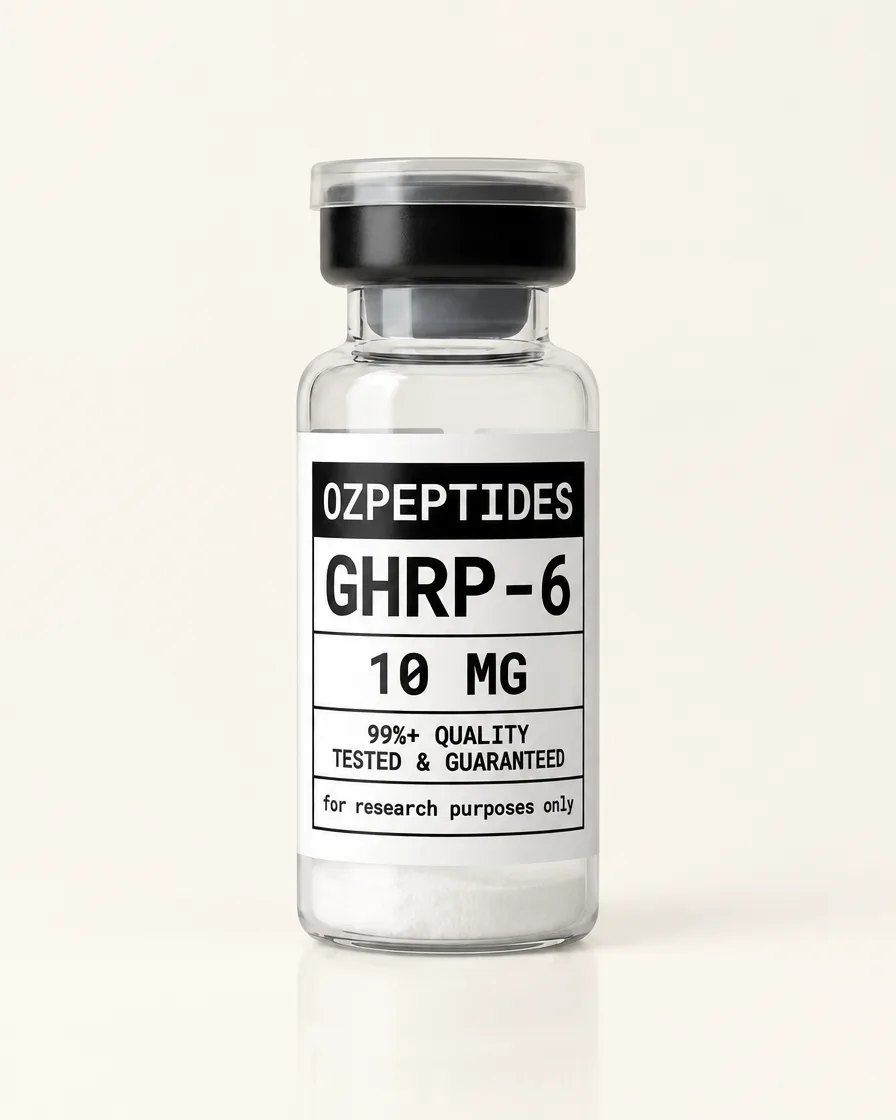
GHRP-6 is supplied in 10MG vials. Reconstituted in 2ML of bacteriostatic water that is 5MG/ML, so a 0.1ML draw is 500mcg.
Working the numbers explicitly matters more than it looks, because the same draw volume delivers different amounts depending on the diluent added — adding 1ML instead of 2ML to the same 10MG vial gives 10MG/ML and doubles what a 0.1ML draw contains. Neither volume is wrong; what matters is knowing the concentration rather than assuming it. It also follows that adding more bacteriostatic water does not make a peptide weaker chemically: it spreads the same quantity through more liquid, which is a distinction that causes real confusion. On a standard 100-unit insulin syringe, where the barrel is 1ML, 0.1ML is the 10-unit mark — and reading in units rather than millilitres is where most arithmetic errors originate. The reconstitution calculator is pre-filled per SKU and reports both.
Research-grade GHRP-6, made in Australia.
Simple to make and simple to misrepresent, so we confirm identity and state the fill: ≥99% HPLC purity, 0 ppm heavy metals, tested batch by batch.
Frequently asked
Ten units on a standard 100-unit insulin syringe, where the full 1ML barrel is 100 units.
It activates GHS-R1a, the ghrelin receptor. Ghrelin is the hormone that signals hunger, so the effect is what the receptor does.
Yes, along with prolactin. That collateral response is why ipamorelin was developed.
For studying ghrelin receptor biology, where the full downstream response is the point rather than a confound.
Yes. WADA S2 names the growth hormone-releasing peptides, prohibited at all times.
The original growth hormone-releasing hexapeptide, acting on the ghrelin receptor GHS-R1a.
Its activity implied an unknown receptor and ligand, which led to the discovery of the GHS receptor and then ghrelin itself.
Ipamorelin is selective and does not carry the appetite, cortisol and prolactin effects to the same degree.
GHRP-6 is available in 10MG.
- Howard AD, et al. A receptor in pituitary and hypothalamus that functions in growth hormone release. Science 1996;273:974–977.
- Kojima M, et al. Ghrelin is a growth-hormone-releasing acylated peptide from stomach. Nature 1999;402:656–660.
This guide summarises published research for educational purposes. It is not medical advice. OzPeptides products are sold for research and laboratory use only, not for human consumption. 18+ only.