Key facts
What is KPV?
KPV is the final three amino acids of alpha-melanocyte-stimulating hormone, synthesised on their own.
Alpha-MSH is best known for pigmentation — it is the pathway the melanotan compounds act on — but it also has well-documented anti-inflammatory activity, and the two effects are carried by different parts of the molecule. KPV is the anti-inflammatory end. Isolating it gives researchers a way to study that activity without triggering melanocortin receptor-driven pigmentation, which is the whole point of using the fragment instead of the hormone.
How does KPV work?
Published work reports it acts intracellularly, interfering with NF-κB signalling rather than through a surface melanocortin receptor.
Studies in intestinal epithelial and immune cells describe KPV entering cells through the PepT1 transporter and reducing NF-κB activation, which lowers production of inflammatory cytokines. That intracellular route is unusual for a peptide this small and distinguishes it from the receptor-mediated activity of full-length alpha-MSH. Being three residues long, it is also cheap and stable to work with — a practical advantage in cell culture.
What is KPV studied for?
Colitis and inflammatory bowel models, and skin inflammation research.
The most-cited work is in mouse colitis models, where orally or rectally administered KPV reduced markers of intestinal inflammation. Other published research covers topical application in skin inflammation and wound models, and there is interest in it as a component of blends such as KLOW. Human trial data is essentially absent; this is an early-stage compound and should be described as one.
Is KPV approved in Australia?
No. KPV is not registered as a medicine and is supplied for research only.
It is not registered in Australia. As a fragment of a peptide hormone with no approved human therapeutic use, it also falls within the WADA Prohibited List's S0 catch-all for athletes subject to anti-doping rules. OzPeptides supplies KPV for in-vitro and laboratory research only, 18+, not for human consumption.
How is research-grade KPV quality verified?
HPLC purity and mass-spec identity per batch, with heavy-metal screening.
A tripeptide is the simplest synthesis in our range, so there is no excuse for a poor batch — and equally, a low price is not evidence of quality, since the raw synthesis is inexpensive either way. What matters is the testing: every OzPeptides batch is made and tested here at ≥99% HPLC purity with 0 ppm heavy metals, with the results recorded against the batch on your vial.
Where does KPV come from?
It is the last three amino acids of alpha-MSH — lysine, proline, valine — synthesised on their own.
Alpha-MSH is a 13-residue hormone that carries two quite separate activities: pigmentation, which is what the melanotan compounds act on, and anti-inflammatory activity. Those activities sit in different parts of the molecule, and KPV is the anti-inflammatory end. That structural fact is the answer to the most common question about it: KPV produces no pigmentation effect, because the part of the hormone responsible for pigmentation is not in it. It is also why KPV appears in blends aimed at inflammation alongside compounds that have nothing to do with melanocortin signalling.
How is KPV reported to work?
Published work describes it entering cells through the PepT1 transporter and reducing NF-κB activation — an intracellular route rather than a surface receptor.
This is unusual for a peptide and it is the most interesting thing about KPV scientifically. Most peptide signalling happens at the cell surface, where a molecule binds a receptor and a cascade follows inside. The KPV literature describes something different: uptake through PepT1, a di- and tripeptide transporter expressed in intestinal epithelium and some immune cells, followed by interference with NF-κB, the transcription factor that drives much of the inflammatory cytokine response. A tripeptide is small enough for that route to be plausible, and the transporter specificity explains why the research concentrates on gut and skin.
How strong is the KPV evidence?
Thin. The most-cited work is mouse colitis models and cell culture, with further research in skin inflammation. Human data is essentially absent.
KPV is one of the compounds in this catalogue where the honest answer is that very little is established. The mechanistic story is coherent and the preclinical results are real, but the total published volume is small, concentrated in a few groups, and confined to animal and in-vitro models. No clinical programme exists. That does not make it uninteresting as a research tool — a small, well-defined tripeptide with a proposed intracellular mechanism is a useful thing to study — but any page presenting KPV as an established anti-inflammatory is far beyond what has been shown.
Is KPV related to the melanotan peptides?
They share a parent hormone and nothing else functionally. MT-1 and MT-2 are alpha-MSH analogues acting on melanocortin receptors; KPV is a fragment with no pigmentation activity.
The relationship is genealogical rather than practical, and confusing the two is a real risk because they appear near each other in any discussion of alpha-MSH. The melanotans are designed to activate melanocortin receptors, chiefly MC1R for pigment, and their whole profile follows from that. KPV does not activate those receptors; its reported activity is intracellular and anti-inflammatory. They are studied by different people for different reasons, and a vial of one is not a substitute for the other in any sense.
Is KPV prohibited in sport?
It has no approval for human therapeutic use anywhere, which places it under the WADA S0 catch-all.
S0 covers pharmacological substances with no current approval by any governmental regulatory health authority for human therapeutic use and not addressed elsewhere on the Prohibited List. KPV has no such approval in any jurisdiction, so athletes subject to anti-doping rules should treat it as prohibited at all times. The absence of a specific named entry is not an exemption — S0 exists for exactly this category of compound.
How is KPV stored and reconstituted?
Lyophilised and cold it is stable for long periods; reconstituted with bacteriostatic water and refrigerated, the practical window is weeks.
A tripeptide is about as simple as a peptide gets and KPV is correspondingly robust, dissolving readily with no special handling. The standard rules still apply: bacteriostatic water rather than sterile for a multi-draw window, diluent directed down the side of the vial, swirl rather than shake, refrigerate and keep out of light once mixed. Because KPV is so small, the milligram figure covers a far larger number of molecules than the same weight of a large peptide, which is worth remembering when comparing across compounds.
What should be checked in a KPV vial?
Identity by mass spectrometry and purity by HPLC. A tripeptide is trivially cheap to synthesise well, so a genuine batch should test essentially clean.
That simplicity cuts both ways. There is little economic incentive to adulterate KPV, but also little excuse for a poor purity figure, so a mediocre certificate on this compound is a statement about the supplier. The one genuine identity question is whether the vial contains KPV or a related melanocortin fragment, which mass spectrometry settles instantly given how different the masses are. We make KPV in Blacktown, NSW, at ≥99% HPLC purity with 0 ppm heavy metals.
Research-grade KPV, made in Australia.
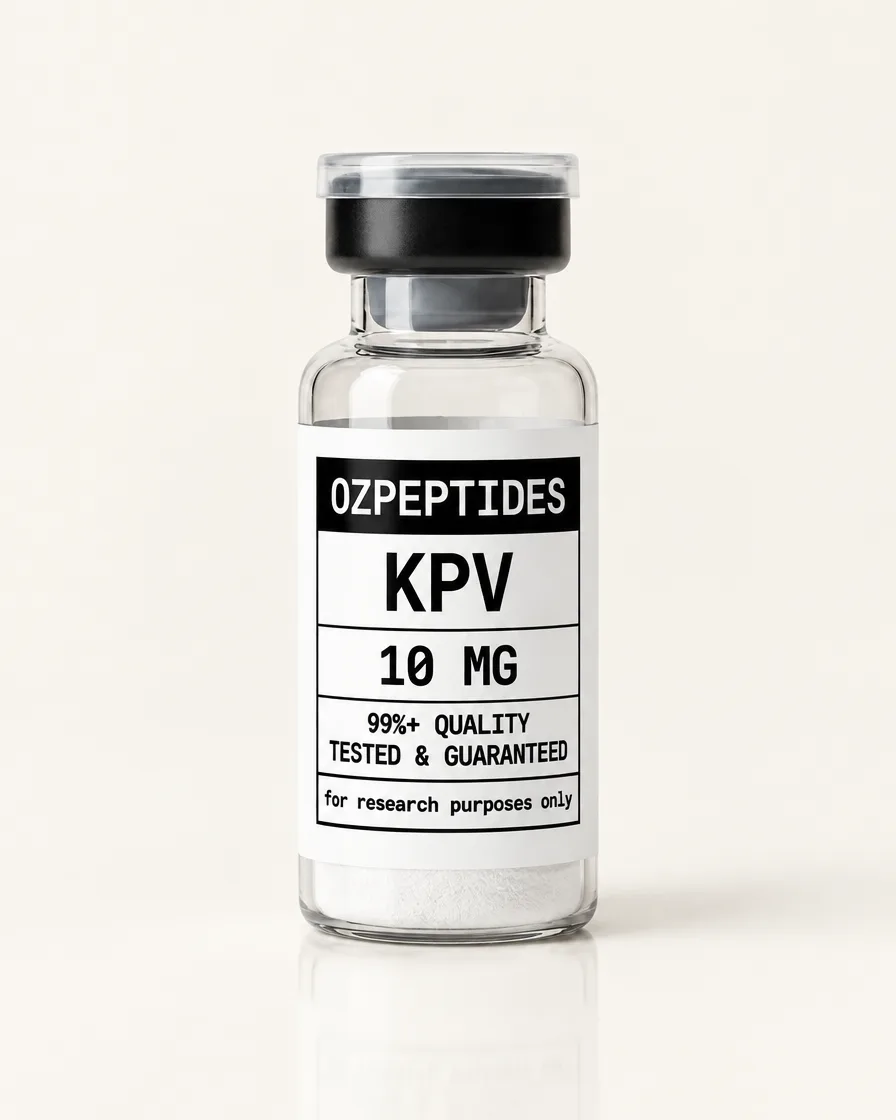
A simple peptide done properly: ≥99% HPLC purity, mass-spec identity, 0 ppm heavy metals, and a results recorded against the batch, from our lab here.
Frequently asked
No. Alpha-MSH carries pigmentation and anti-inflammatory activity in different parts of the molecule, and KPV is the anti-inflammatory fragment.
Published work describes uptake through the PepT1 transporter, followed by reduced NF-κB activation — an intracellular route rather than a surface receptor.
Essentially none. The published work is mouse colitis models, skin inflammation research and cell culture.
It has no approval for human therapeutic use anywhere, which places it under the WADA S0 catch-all. Treat it as prohibited at all times.
A tripeptide (lysine-proline-valine) that forms the C-terminal fragment of alpha-MSH, studied for anti-inflammatory activity.
Mainly colitis and inflammatory bowel models, plus skin inflammation research.
KPV is available in 10MG.
- Dalmasso G, et al. PepT1-mediated tripeptide KPV uptake reduces intestinal inflammation. Gastroenterology 2008;134:166–178.
- Kannengiesser K, et al. Melanocortin-derived tripeptide KPV has anti-inflammatory potential in murine models of inflammatory bowel disease. Inflamm Bowel Dis 2008;14:324–331.
This guide summarises published research for educational purposes. It is not medical advice. OzPeptides products are sold for research and laboratory use only, not for human consumption. 18+ only.