Key facts
What is ARA-290?
ARA-290 is a short peptide copied from one face of the erythropoietin molecule — the part associated with tissue protection rather than blood production.
Erythropoietin does two quite different jobs. The familiar one is stimulating red blood cell production, which is also what makes it a doping agent. The second, identified later, is a tissue-protective signal acting through a different receptor complex. ARA-290 reproduces only the region responsible for the second, which is why it is described as non-erythropoietic: published work reports it does not raise haematocrit.
How does ARA-290 work?
It acts on the innate repair receptor, a complex of the EPO receptor with the beta-common receptor, rather than on the classical EPO receptor homodimer.
The classical EPO receptor is a homodimer and drives erythropoiesis. The innate repair receptor pairs that receptor with the beta-common receptor subunit and is expressed on cells involved in injury response and inflammation. Selecting for that complex is the design premise, and it is why ARA-290 is one of the more mechanistically well-defined compounds in this range — the target is named, not inferred.
What is ARA-290 studied for?
Small-fibre neuropathy, particularly in sarcoidosis and diabetes, plus other neuropathic and inflammatory models.
Unlike most compounds in our repair range, ARA-290 has been through registered human trials: published phase 2 work in sarcoidosis-associated small-fibre neuropathy reported improvements in corneal nerve fibre measures and symptom scores, and there is related work in type 2 diabetes neuropathy. The trials are small. That is genuine clinical data, and it is also not the same thing as an approved treatment.
Is ARA-290 approved in Australia?
No. It has been trialled but not registered, here or elsewhere.
ARA-290 is not registered in Australia. For athletes it is worth noting that while it is reported as non-erythropoietic, peptides derived from EPO fall within the WADA S2 category and the S0 catch-all. OzPeptides supplies ARA-290 for in-vitro and laboratory research only, 18+, not for human consumption.
How is research-grade ARA-290 quality verified?
Purity by HPLC, identity by mass spectrometry, heavy metals screened, per batch.
The value of ARA-290 in research is its selectivity, and selectivity depends entirely on the sequence being exactly right — a fragment with the wrong residue is not a more-or-less version of the compound, it is a different one. That is what mass-spec identity confirmation is for. Every OzPeptides batch is made and tested here at ≥99% HPLC purity with 0 ppm heavy metals and the results recorded against the batch.
What is ARA-290 derived from?
Erythropoietin. ARA-290, also called cibinetide, is an 11-amino-acid peptide reproducing a region of the EPO molecule that is not involved in red blood cell production.
EPO has two quite separate activities, and separating them is the entire point of this compound. The haematopoietic effect — stimulating red blood cell production — comes from binding the classical EPO receptor homodimer, and it is why EPO is both a medicine and a notorious doping agent. A second, tissue-protective activity was later attributed to a different receptor complex, the innate repair receptor, formed of the EPO receptor and the beta-common receptor. ARA-290 was designed to engage the second without the first, which is a genuinely clever piece of design whether or not the clinical results followed.
What is the innate repair receptor?
A heteroreceptor complex of the EPO receptor and the beta-common receptor, proposed as the route for EPO's tissue-protective effects rather than its blood effects.
The proposal came out of work showing that EPO protected tissue in models where its effect on red cells could not explain the result, and that the protection persisted with EPO derivatives that did not stimulate erythropoiesis. ARA-290 is the peptide built on that reasoning: it reproduces the relevant helix B surface of EPO and is reported to engage the repair complex selectively. The receptor model itself is not universally accepted, and that uncertainty is part of an honest account of the compound rather than a footnote to it.
How far did ARA-290 get in clinical research?
Further than most compounds here. It reached clinical trials in sarcoidosis-associated small fibre neuropathy, with published results, and holds orphan drug designations.
This is unusual in this catalogue and worth stating precisely. ARA-290, as cibinetide, has been studied in humans with published trial results, including work reporting improvements in corneal nerve fibre measures and patient-reported neuropathic symptoms in small fibre neuropathy. It has orphan designations in the United States and Europe. What it does not have is a registration: no regulator has approved it, and it is not registered in Australia. A real clinical programme that has not produced an approved product is the accurate summary.
Does ARA-290 raise haemoglobin like EPO?
It is specifically designed not to, and published work reports no effect on haemoglobin or haematocrit.
That is the compound's central design claim and the reason it exists. EPO's red-cell effect carries real risk — increased blood viscosity and thrombotic events — and any tissue-protective use of EPO itself runs into it. ARA-290 reproducing only the helix B surface is the attempt to avoid that, and the trials that measured haematological parameters reported no change. It is a rare example in this catalogue of a specific, falsifiable safety claim that was actually tested in people rather than asserted.
Is ARA-290 prohibited in sport?
It has no regulatory approval for human therapeutic use, placing it under the WADA S0 catch-all, and its EPO lineage invites scrutiny regardless.
The fact that ARA-290 does not raise haemoglobin does not exempt it: S0 covers substances with no current approval for human use, and ARA-290 has none. Its relationship to EPO — the substance at the centre of endurance-sport doping for three decades — means any athlete found with it would face a difficult argument, and the sensible position is to treat it as prohibited at all times.
How is ARA-290 stored and reconstituted?
Lyophilised and cold for long-term storage; bacteriostatic water for reconstitution, refrigerated, with a practical window of weeks.
An 11-residue peptide dissolves readily and is not especially fragile. The standard handling applies: bacteriostatic water rather than sterile for a multi-draw vial, diluent directed down the side, swirl rather than shake since foaming indicates denatured peptide, refrigerate and keep out of light once mixed. The reconstitution calculator carries the arithmetic for the strengths we stock rather than a generic worked example.
What should be checked in an ARA-290 vial?
Identity by mass spectrometry and purity by HPLC, with the same attention to fill weight as any peptide sold without a regulator checking it.
ARA-290 is less widely counterfeited than the better-known compounds, mostly because it is less widely known, but the failure modes are identical: underfilling, which purity testing never catches, and relabelled imported stock carrying a certificate from a different batch. We make ARA-290 in Blacktown, NSW, at ≥99% HPLC purity with 0 ppm heavy metals, with the vial batch number resolving to its own certificate of analysis.
Research-grade ARA-290, made in Australia.
A compound whose value is its exact sequence, so we confirm it: mass-spec identity, ≥99% HPLC purity, 0 ppm heavy metals, tested batch by batch.
Frequently asked
Erythropoietin. It reproduces a region of the EPO molecule associated with tissue protection rather than red blood cell production.
Published work reports no effect on haemoglobin or haematocrit. Avoiding that effect is the compound's central design goal.
Yes, as cibinetide, in small phase 2 trials in sarcoidosis-associated small fibre neuropathy, with published results and orphan drug designations — but no registration anywhere.
A proposed heteroreceptor complex of the EPO receptor and the beta-common receptor, the route ARA-290 is designed to engage.
An 11-amino-acid peptide derived from erythropoietin, also known as cibinetide, studied for tissue-protective signalling.
No. It remains investigational.
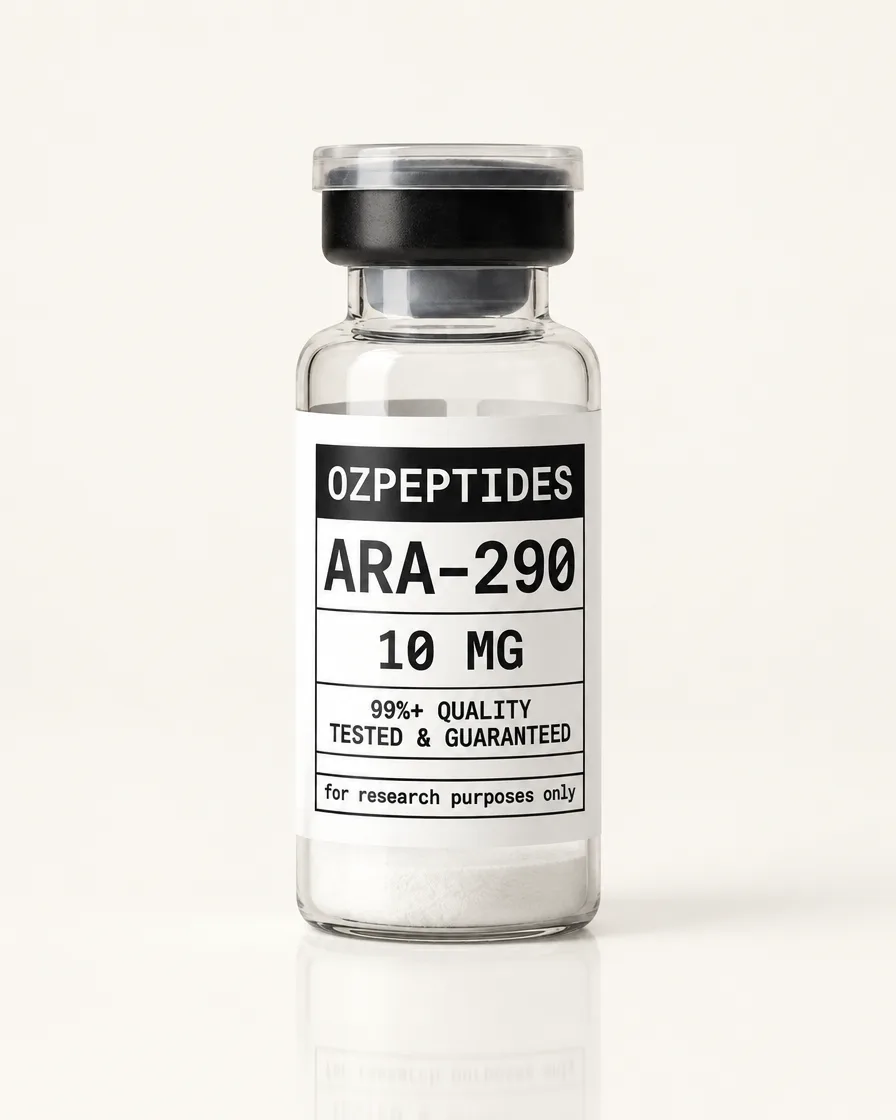
ARA-290 is available in 10MG.
- Dahan A, et al. ARA 290 improves symptoms in patients with sarcoidosis-associated small nerve fiber loss and increases corneal nerve fiber density. Mol Med 2013;19:334–345.
- Brines M, et al. Nonerythropoietic, tissue-protective peptides derived from the tertiary structure of erythropoietin. Proc Natl Acad Sci USA 2008;105:10925–10930.
This guide summarises published research for educational purposes. It is not medical advice. OzPeptides products are sold for research and laboratory use only, not for human consumption. 18+ only.