Key facts
What is TB-500?
TB-500 is the synthesised active portion of thymosin beta-4, rather than the whole 43-amino-acid protein.
Thymosin beta-4 is one of the most abundant proteins in many human cell types and is present in wound fluid and platelets. TB-500 reproduces the short region responsible for its actin-binding activity, which makes it cheaper and more practical to synthesise than the full protein. The two names get used interchangeably in marketing, which is sloppy: a fragment and a full-length protein are not the same compound, and research on one does not automatically transfer to the other.
How does TB-500 work?
It binds G-actin, the monomer form of actin, which is associated with cytoskeletal remodelling and cell migration.
Cell migration is a prerequisite for repair: cells have to reach a damaged site before anything can be rebuilt, and that movement depends on continuous assembly and disassembly of the actin cytoskeleton. By sequestering actin monomers, thymosin beta-4 acts as a regulator of that process. Published work also reports effects on angiogenesis and on inflammatory signalling in injury models, though the actin mechanism is the best characterised.
What is TB-500 studied for?
Wound healing, cardiac injury, corneal repair and muscle injury models.
Thymosin beta-4 itself has been through early-phase human trials in dry eye and epidermolysis bullosa, and has been studied in cardiac repair models after infarction. TB-500 as a fragment appears mostly in preclinical work and in veterinary use, particularly in racehorses — which is also why it has an anti-doping history. Direct human trial data on the fragment is limited.
Is TB-500 approved in Australia?
No. It is unapproved here and prohibited in sport.
TB-500 is not registered in Australia, and WADA prohibits it under S2 alongside other growth factors affecting muscle, tendon or ligament repair and vascularisation. It has an established history in equine doping cases, so anyone in regulated sport — human or equine — should treat it as banned. OzPeptides supplies TB-500 for in-vitro and laboratory research only, 18+, not for human consumption.
How is research-grade TB-500 quality verified?
Purity by HPLC, identity by mass spectrometry, plus heavy-metal screening.
Because "TB-500" and "thymosin beta-4" are used loosely across the market, identity confirmation matters more here than almost anywhere else in the range: mass spectrometry is what tells you which molecule is actually in the vial. Every OzPeptides batch is made and tested in Australia at ≥99% HPLC purity with 0 ppm heavy metals, with the results recorded against your batch.
Is TB-500 the same as thymosin beta-4?
No, and the names are used interchangeably in marketing when they should not be. Thymosin beta-4 is a 43-amino-acid protein; TB-500 is a short synthetic peptide reproducing its actin-binding region.
This is the single most common error in how TB-500 is described, and it matters because the published research is not evenly split between the two. Most of the peer-reviewed work — including the clinical trials that were run — concerns the full thymosin beta-4 protein, not the fragment. TB-500 is assumed to carry the relevant activity because the actin-binding domain is the part thought to drive the effects, but assumption is the operative word. A page citing thymosin beta-4 trials as evidence for TB-500 is transferring results between two different molecules, and the honest version says so.
What does actin binding have to do with repair?
Cell migration depends on continuous assembly and disassembly of the actin cytoskeleton, and cells have to reach a site before anything is rebuilt there.
Actin is the cell's structural scaffolding and its engine of movement: a cell crawls by polymerising actin at its leading edge and disassembling it behind. Thymosin beta-4 is the principal actin-sequestering protein in mammalian cells, holding a reservoir of monomeric actin available for that process. A compound that interacts with this system is therefore plausibly involved in cell migration, which is an early and necessary step in tissue repair. It is a coherent mechanistic story, and it is a mechanism about cells arriving rather than about tissue being built — a distinction that gets lost when TB-500 is described simply as a healing peptide.
What does the TB-500 evidence actually cover?
Preclinical animal work, mostly on the parent protein. Thymosin beta-4 reached clinical trials for corneal and skin wounds; TB-500 itself has no clinical record.
The thymosin beta-4 clinical programme is the strongest evidence in this area and it is genuinely interesting — trials in dry eye, corneal injury and venous stasis ulcers, with results that did not lead to a registered product. That programme was for the protein. The fragment sold as TB-500 inherits none of it directly. What TB-500 has in its own name is animal work, mostly cardiac and soft-tissue models, and a great deal of grey-market assertion. Separating the two is the most useful thing any summary of this compound can do.
Is TB-500 prohibited in sport?
Yes. WADA lists it under S2, which covers growth factors and related substances affecting muscle, tendon or ligament repair, prohibited at all times.
S2 is a different section from the S0 catch-all that covers BPC-157, and the distinction is about classification rather than severity: both are prohibited at all times, in and out of competition. TB-500 is specifically named, and anti-doping laboratories have established detection methods for it. Its history in sport is long — it appeared in equine doping cases before human ones — and any athlete subject to the World Anti-Doping Code should treat it as prohibited without qualification.
How does TB-500 differ from BPC-157?
Different mechanisms and different literatures. TB-500 is associated with actin binding and cell migration; BPC-157 with angiogenesis and growth-factor signalling.
They are routinely sold together and described as complementary, which is a mechanistic argument rather than a tested one — no study covers the pair. The clearest way to hold them apart is by what each is reported to do: TB-500 relates to cells reaching a site, BPC-157 to the blood supply and signalling that supports rebuilding there. They also differ in classification, with BPC-157 under WADA S0 and TB-500 under S2, and in evidence shape: BPC-157 has a larger rodent literature in its own name, TB-500 a parent protein with a real clinical record it does not fully inherit.
How is TB-500 stored and reconstituted?
Lyophilised and cold it is stable for long periods; reconstituted with bacteriostatic water and refrigerated, the working window is weeks.
TB-500 is a short linear peptide and behaves like one: it dissolves readily and is not fragile, but the handling rules still apply. Bacteriostatic water rather than sterile water is what allows a vial to be drawn from repeatedly over weeks, since the benzyl alcohol inhibits bacterial growth. Direct the diluent down the side of the vial and swirl; foaming indicates denatured peptide. Keep it refrigerated and out of light once mixed. A 10MG vial in 2ML gives 5MG/ML, and the reconstitution calculator carries the per-strength arithmetic.
What should be checked in a TB-500 vial?
Identity by mass spectrometry, purity by HPLC and the fill weight — with particular attention to whether the vial contains the fragment or something else.
Because TB-500 and thymosin beta-4 are sold under overlapping names, identity confirmation here is not a formality: the two have very different molecular weights and mass spectrometry distinguishes them immediately. Beyond that the usual failures apply — underfilled vials, which a purity figure never catches, and relabelled imported stock with a certificate that belongs to a different batch. We make TB-500 in Blacktown, NSW, and test every batch here at ≥99% HPLC purity with 0 ppm heavy metals.
Research-grade TB-500, made in Australia.
Identity confirmed by mass spec, so you know which molecule is in the vial: ≥99% HPLC purity, 0 ppm heavy metals, results recorded against the batch, made here.
Frequently asked
No. Thymosin beta-4 is a 43-amino-acid protein; TB-500 is a short synthetic peptide reproducing its actin-binding region. Research on one does not automatically apply to the other.
Yes, under WADA S2, prohibited at all times. Anti-doping laboratories have established detection methods for it.
Yes — in dry eye, corneal injury and venous stasis ulcers. Those trials were of the protein, not of TB-500, and did not lead to a registered product.
Because they are associated with different parts of the same process. That is a mechanistic argument; no study covers the combination.
A synthetic peptide reproducing the active, actin-binding region of thymosin beta-4.
Our pre-blended vial of TB-500 and BPC-157, the two compounds most often studied together in repair models.
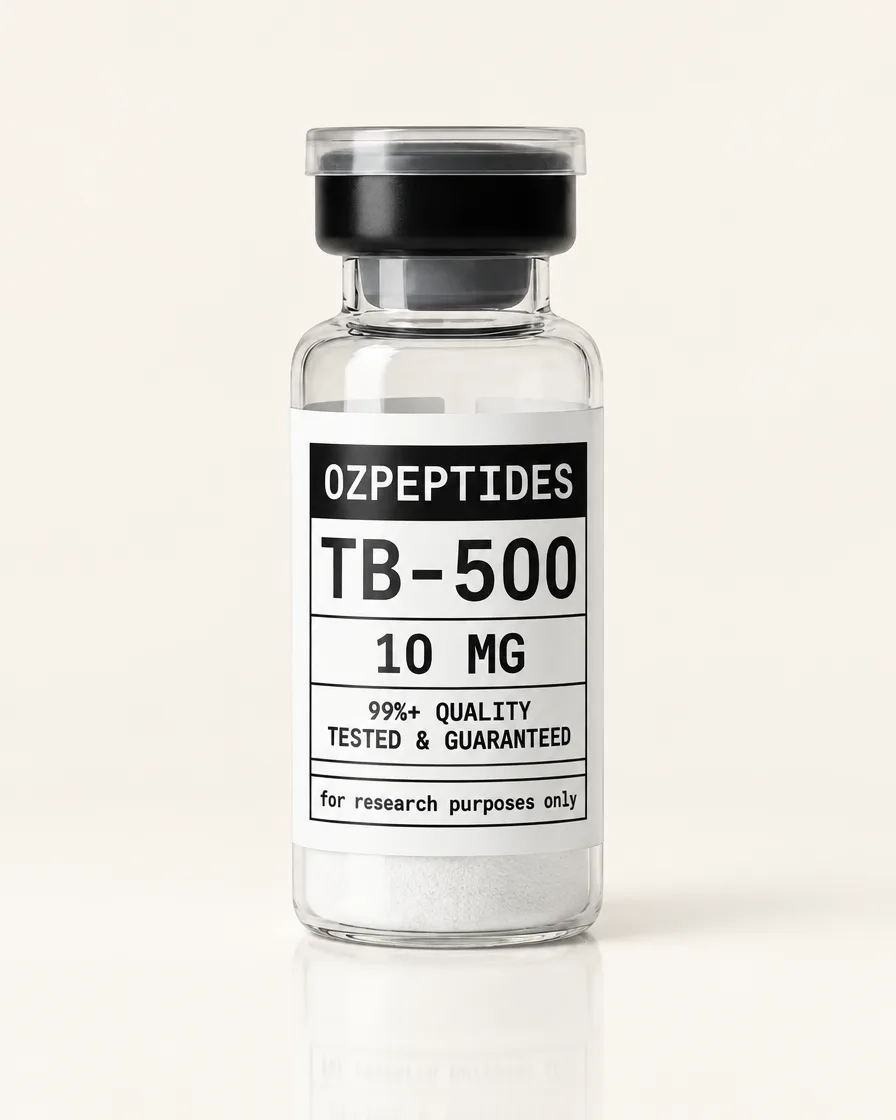
TB-500 is available in 10MG.
- Goldstein AL, Hannappel E, Kleinman HK. Thymosin β4: actin-sequestering protein moonlights to repair injured tissues. Trends Mol Med 2005;11:421–429.
- Malinda KM, et al. Thymosin β4 accelerates wound healing. J Invest Dermatol 1999;113:364–368.
- World Anti-Doping Agency. Prohibited List — Section S2.
This guide summarises published research for educational purposes. It is not medical advice. OzPeptides products are sold for research and laboratory use only, not for human consumption. 18+ only.