Key facts
What is the Wolverine Stack?
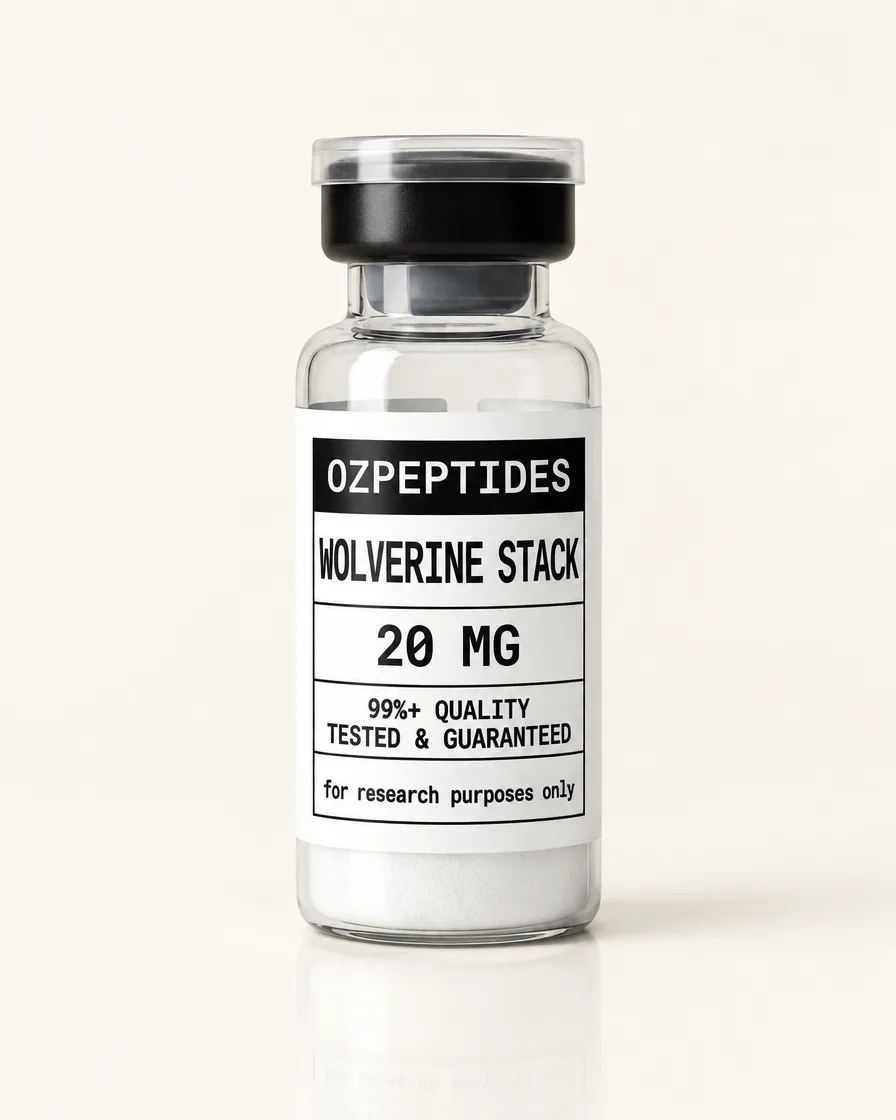
It is a single vial containing both TB-500 and BPC-157, prepared and tested together in our lab.
The name comes from the research pairing rather than from anything in the literature: these two compounds turn up together so often in soft-tissue work that a combined vial is simply more practical than two. The blend is prepared by weight in our own lab, lyophilised together, and tested as one product — so what we test is what is actually in the vial rather than two separate inputs.
Why are TB-500 and BPC-157 studied together?
Because their reported mechanisms are complementary rather than overlapping.
The published rationale is that they act on different parts of the same process: TB-500 on actin dynamics and cell migration, BPC-157 on angiogenesis and growth-factor signalling. Repair models need both — cells have to arrive and the tissue needs blood supply. That said, controlled research directly comparing the blend against either compound alone is scarce, so the combination rests more on mechanism than on head-to-head data. Saying otherwise would overstate it.
What is the stack studied for?
Soft-tissue repair models — tendon, ligament and muscle.
Research on the individual compounds covers tendon-to-bone healing, ligament injury, muscle crush models and gut lesions. Work on the combination specifically is thinner, and mostly in animal models. For laboratory use, the practical advantage is consistency: the same ratio in every vial, from the same tested batch, rather than two reconstitutions weighed by hand.
Is the Wolverine Stack approved in Australia?
No. Neither component is approved, and both are prohibited in sport.
BPC-157 is listed by WADA under S0 and TB-500 under S2, so the blend is prohibited in competitive sport at all times. Neither compound is registered in Australia. OzPeptides supplies the stack strictly for in-vitro and laboratory research, 18+, not for human consumption.
How is the blend quality verified?
Tested as a finished blend, not as two separate inputs.
Blending introduces one risk a single compound does not have: the ratio. We prepare the blend by weight in our own Australian lab and test the finished product, confirming identity of both peptides by mass spectrometry and purity by HPLC, with heavy-metal screening. The results are recorded against the blend's batch number, the one printed on your vial.
What is in the Wolverine blend?
BPC-157 and TB-500 together in one vial, prepared by weight so the ratio is identical from vial to vial.
The name is market vernacular rather than science, and it is worth saying so plainly: there is no compound called Wolverine, only a blend of two peptides that are routinely used together. What the blend actually offers is practical. One reconstitution instead of two, one ratio that does not depend on someone weighing two powders by hand, and one batch certificate covering the finished product rather than two certificates for inputs that were never tested together. For anyone running the two compounds in parallel, that is a genuine reduction in handling error, which is different from and more defensible than a claim about synergy.
Why are these two combined?
Because their reported mechanisms address different parts of the same process: cell migration for TB-500, angiogenesis and growth-factor signalling for BPC-157.
Tissue repair requires several things at once. Cells have to reach the site, which is where actin-mediated migration comes in; blood supply has to develop, which is the angiogenesis arm; and signalling has to coordinate what happens there. TB-500 is associated with the first, BPC-157 with the second and third. Combining them is therefore a reasonable hypothesis about complementary mechanisms — and a hypothesis is exactly what it remains. No published study covers the combination, and anyone describing the blend as proven is describing something that does not exist.
Is there research on the blend itself?
No. The published literature covers each peptide separately, mostly in rodent models, and neither has meaningful human clinical data.
This is the most important sentence on the page and the one most blend listings omit. The evidence for a combination is not the sum of the evidence for its parts: interactions can be additive, redundant or antagonistic, and only a study of the combination can distinguish them. What the individual literatures show is set out in the BPC-157 and TB-500 guides, including where each is thin — the heavy reliance on a small number of groups for BPC-157, and the gap between TB-500 and the parent protein whose trials are usually cited for it.
Is the blend prohibited in sport?
Yes, twice over. BPC-157 is listed under WADA S0 and TB-500 under S2, both prohibited at all times.
A blend inherits the status of everything in it, and in this case both components are independently prohibited under the World Anti-Doping Code — one under the catch-all for substances with no human therapeutic approval, one under the growth-factor section. Both are prohibited in and out of competition, and anti-doping laboratories have detection methods for both. There is no version of this blend that is permissible for an athlete subject to the Code.
How is a two-peptide blend reconstituted?
As one vial. Bacteriostatic water, directed down the side, swirled not shaken, refrigerated after mixing, with a practical window of weeks.
The convenience of a blend is that the handling is single-vial handling, and the risk is that a single handling error affects both peptides at once. Foaming indicates denatured peptide and in a blend there is no way to tell which component was affected, so the swirl-not-shake rule matters more here than in a single-compound vial. The reconstitution arithmetic works on total peptide: the calculator resolves each component in the ratio the batch was made to, which is more useful than calculating on the total and assuming.
How should the milligram figure on a blend be read?
As total peptide across both components. The number that matters for any calculation is the per-component amount, which is why a blend has to state its ratio.
Comparing a blend to a single peptide on price per milligram is misleading in both directions, because the milligrams are not of the same thing. A blend's headline weight is a sum; the useful figure is what each component contributes, and that is only knowable if the supplier states the ratio and tests the finished product rather than the inputs. Ours are prepared by weight in our own lab and the finished blend is what gets tested, so the ratio on the certificate is the ratio in the vial rather than the ratio intended.
What should be checked in a blend vial?
Both peptides confirmed by mass spectrometry, purity by HPLC on the finished product, and the stated ratio verified rather than assumed.
A blend has as many chances to go wrong as it has components, and the specific grey-market failure is a vial that contains one peptide at the stated total weight rather than two at the stated ratio — which tests clean on purity and cannot be detected by eye. Testing the finished product rather than the inputs is what catches it. We make the blend in Blacktown, NSW, at ≥99% HPLC purity with 0 ppm heavy metals, and both components are confirmed by mass spectrometry in the vial as sold.
Wolverine Stack, blended and tested in Australia.
Blended by weight in our own lab and tested as a finished product, so the ratio we test is the ratio in the vial. ≥99% HPLC purity, 0 ppm heavy metals.
Frequently asked
No. It is market vernacular for a blend of BPC-157 and TB-500 in one vial.
Not as a blend. The published work covers each peptide separately, mostly in rodent models.
Yes. BPC-157 is listed under WADA S0 and TB-500 under S2, both prohibited at all times.
Total peptide across both components. The per-component amount is the figure any calculation needs, which is why the ratio has to be stated.
TB-500 and BPC-157, pre-blended and lyophilised in a single vial.
One reconstitution, one consistent ratio in every vial, and one set of results covering the finished product.
10MG and 20MG total peptide, as a vial, pre-mixed or in a pen cartridge, with mixing at no extra cost (or $5 more per vial while a sale is running).
- Goldstein AL, Hannappel E, Kleinman HK. Thymosin β4: actin-sequestering protein moonlights to repair injured tissues. Trends Mol Med 2005;11:421–429.
- Sikiric P, et al. Stable gastric pentadecapeptide BPC 157: novel therapy in gastrointestinal tract. Curr Pharm Des 2011;17:1612–1632.
This guide summarises published research for educational purposes. It is not medical advice. OzPeptides products are sold for research and laboratory use only, not for human consumption. 18+ only.