Key facts
What is retatrutide?
Retatrutide is a single synthetic peptide that acts on three metabolic hormone receptors, developed by Eli Lilly and still in clinical trials.
It belongs to the incretin family of metabolic research compounds — the same lineage as semaglutide and tirzepatide — but where those act on one and two receptors respectively, retatrutide acts on three. The third, the glucagon receptor, is the one that sets it apart: glucagon signalling is associated with energy expenditure rather than appetite alone, which is why researchers describe retatrutide as a different mechanism rather than a stronger version of what came before. It has not completed phase 3 trials anywhere in the world, so every result published so far is early-stage.
How does retatrutide work?
It combines three hormone signals in one molecule: GLP-1 and GIP, both incretins, plus glucagon.
GLP-1 and GIP are released by the gut after eating and are involved in insulin release and satiety signalling. Glucagon is usually thought of as insulin's opposite, raising blood glucose — but glucagon receptor agonism is also associated with increased energy expenditure and hepatic fat handling. Combining all three in a single peptide is the design premise: the incretin arms handle intake signalling while the glucagon arm addresses expenditure. Balancing them is the difficult part, and it is what the published dose-finding work has concentrated on.
What is retatrutide studied for?
Mainly obesity, type 2 diabetes and related metabolic research.
The two most-cited studies are both phase 2 and both published in 2023: a 48-week obesity trial in the New England Journal of Medicine, and a type 2 diabetes trial in The Lancet. Smaller published work has looked at hepatic steatosis. Because the programme is mid-stage, there is no long-term safety or outcome data, and no head-to-head phase 3 comparison with tirzepatide. In laboratory research, retatrutide is used to study receptor selectivity and the metabolic effects of combined incretin and glucagon signalling.
Is retatrutide approved in Australia?
No. Retatrutide is not approved for therapeutic use in Australia.
It is not registered in Australia, because it is still an investigational compound everywhere in the world. That is a different situation from semaglutide or tirzepatide, which are registered prescription medicines here under brand names. OzPeptides supplies retatrutide strictly for in-vitro and laboratory research, to buyers aged 18 and over, and not for human consumption.
How is research-grade retatrutide quality verified?
By HPLC purity testing, mass-spec identity confirmation and heavy-metal screening, with the results on batch results.
Retatrutide is a long peptide, which makes purity harder to hold than a short one: incomplete sequences and deletion products are the usual contaminants, and they are what HPLC is there to catch. Every OzPeptides batch is tested in our own Australian lab before release — at least 99% purity by HPLC, identity confirmed by mass spectrometry so the compound matches the label, and screening for lead, mercury, arsenic and cadmium. The results are recorded against the batch number on your vial, not against a generic sample.
Who developed retatrutide, and when?
Eli Lilly, as LY3437943. It was first described publicly around 2022 and the phase 2 results that made its name were published in 2023.
Retatrutide is the third step in a line Lilly has been building for a decade: a GLP-1 agonist, then tirzepatide adding GIP, then a molecule adding glucagon on top of both. The development name LY3437943 still appears throughout the literature and is worth knowing, because searching the trial registries by brand name finds nothing — there is no brand name, and there will not be one until a regulator registers it. The phase 3 TRIUMPH programme is running; nothing from it has reported.
How strong is the evidence for retatrutide?
Two phase 2 trials, published in 2023. No completed phase 3, no long-term safety data, and no cardiovascular outcome data anywhere.
This is the single most important thing to understand about retatrutide, and the thing most pages selling it gloss over. Phase 2 measures whether a compound does something over months in a few hundred people. Phase 3 measures whether it is safe and effective over years in thousands, and it is where compounds routinely fail. Semaglutide and tirzepatide have both been through it; retatrutide has not. Any comparison presenting the three as equivalently established is describing something that is not true.
Why add a glucagon receptor at all?
Glucagon receptor agonism is associated with increased energy expenditure and hepatic fat handling — a different arm of metabolism from the intake signalling the incretins govern.
Glucagon is usually taught as insulin's opposite, which makes its appearance in a metabolic research compound look contradictory. The reasoning is that glucagon receptor activation raises energy expenditure and is associated with reduced liver fat, and that pairing it with incretin agonism offsets the glycaemic effect that would otherwise be a problem. Whether that balance holds over years is precisely what has not been established, and it is the mechanistic reason retatrutide cannot simply be assumed to behave like a stronger tirzepatide.
Is retatrutide prohibited in sport?
It has no approval for human therapeutic use anywhere, which places it under the WADA S0 catch-all for athletes in any code following the Code.
S0 covers any pharmacological substance not addressed by the other sections of the Prohibited List and with no current approval by any governmental regulatory health authority for human therapeutic use. Retatrutide fits that description exactly. Athletes subject to anti-doping rules should treat it as prohibited at all times, and the absence of a specific named listing is not a loophole — S0 exists precisely to cover compounds like this one.
How is retatrutide stored and reconstituted?
Lyophilised and cold, it is stable for long periods. Reconstituted with bacteriostatic water and refrigerated, the practical window is weeks.
Bacteriostatic water rather than sterile water is the usual choice because the benzyl alcohol in it inhibits bacterial growth, which is what turns a single-use vial into one that can be drawn from repeatedly over weeks. Direct the diluent down the side of the vial and swirl rather than shake: foaming indicates denatured peptide. A 10MG vial reconstituted in 2ML gives 5MG/ML, so a 0.1ML draw is 500mcg — the calculator does this per strength.
What goes wrong with retatrutide in the grey market?
Underfilling and substitution. Retatrutide is expensive to synthesise, and semaglutide or tirzepatide relabelled as retatrutide is a known failure.
A vial short of its stated fill weight tests clean on purity — purity measures what fraction of what is there is the right molecule, not how much is there. The two checks that catch these failures are mass spectrometry, which confirms the molecule is retatrutide and not a cheaper incretin, and the fill weight on the certificate. Every OzPeptides batch is made and tested in Blacktown, NSW, at ≥99% HPLC purity with 0 ppm heavy metals, and the batch number on the vial links to its certificate.
Retatrutide vs tirzepatide vs semaglutide
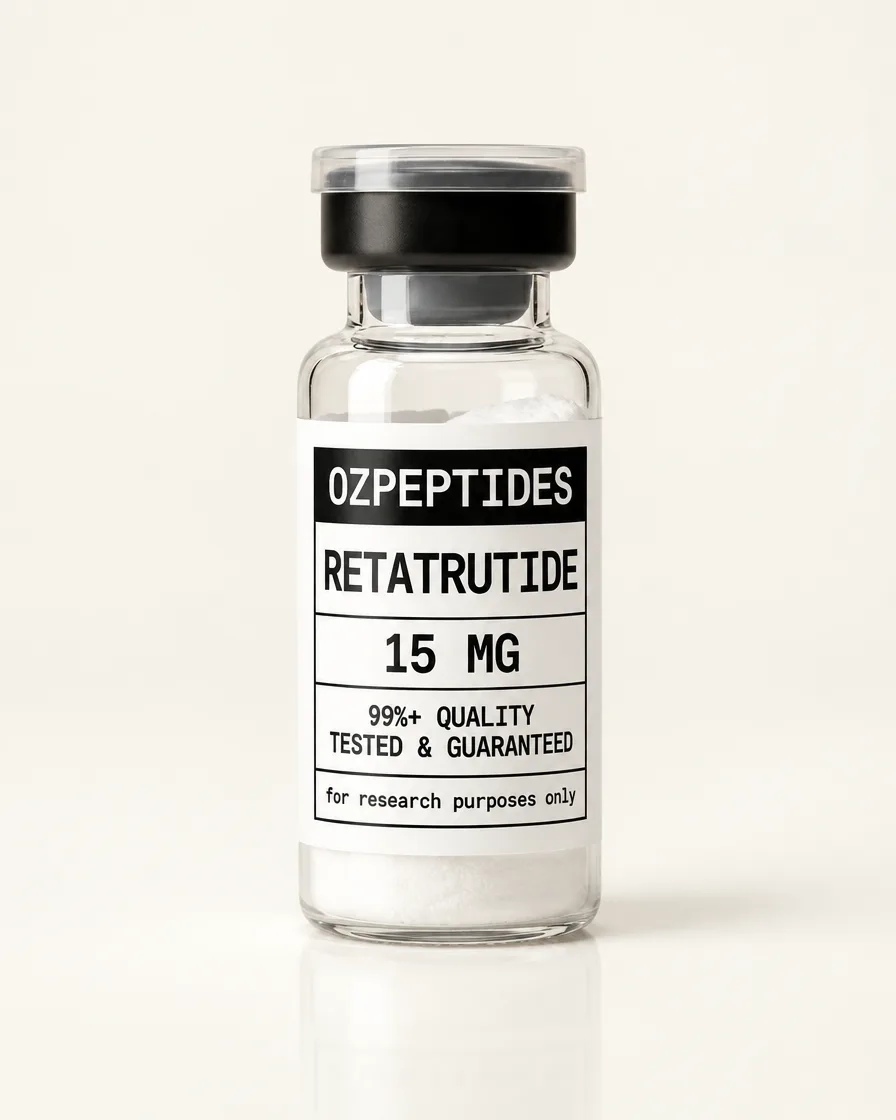
Research-grade retatrutide, made in Australia.
We synthesise and test retatrutide in our own Australian lab: ≥99% HPLC purity, identity confirmed by mass spec, 0 ppm heavy metals and the results recorded against the batch on your vial. No nasties. No guess work from China.
Frequently asked
No. Two phase 2 trials were published in 2023 and the phase 3 TRIUMPH programme is running, with nothing reported.
Eli Lilly's development code for retatrutide. It is the name used throughout the trial registries and much of the literature.
It falls under the WADA S0 catch-all, which covers substances with no current approval for human therapeutic use anywhere. Treat it as prohibited at all times.
Glucagon receptor agonism is associated with energy expenditure and hepatic fat handling, a different mechanism from the appetite and glucose signalling of GLP-1 and GIP.
Retatrutide (LY3437943) is an investigational single-peptide triple agonist that activates the GIP, GLP-1 and glucagon receptors. It is studied in metabolic and obesity research.
Semaglutide targets one receptor (GLP-1). Tirzepatide targets two (GIP and GLP-1). Retatrutide targets three: GIP, GLP-1 and glucagon.
No. Retatrutide is not approved for therapeutic use in Australia. OzPeptides supplies it strictly for research and laboratory use.
Retatrutide is available in 5MG, 10MG, 15MG, 20MG and 30MG, as a vial, pre-mixed or in a pen cartridge, with mixing at no extra cost (or $5 more per vial while a sale is running).
OzPeptides synthesises and tests retatrutide in its own Australian lab, with ≥99% HPLC purity, heavy-metal screening and the results recorded against the batch on your vial.
- Jastreboff AM, et al. Triple–Hormone-Receptor Agonist Retatrutide for Obesity — A Phase 2 Trial. N Engl J Med 2023;389:514–526.
- Rosenstock J, et al. Retatrutide, a GIP, GLP-1 and glucagon receptor agonist, for people with type 2 diabetes: a randomised, double-blind, placebo and active-controlled, parallel-group, phase 2 trial. Lancet 2023;402:529–544.
This guide summarises published research for educational purposes. It is not medical advice. OzPeptides products are sold for research and laboratory use only, not for human consumption. 18+ only.