Key facts
What is tirzepatide?
Tirzepatide is a synthetic 39-amino-acid peptide engineered to activate two incretin receptors at once.
It is based on the GIP sequence and modified so that it also activates the GLP-1 receptor, with a fatty-acid chain for albumin binding and a weekly half-life. That design makes it the first dual incretin agonist to reach the market, and the compound that demonstrated combined incretin signalling was worth pursuing — which is the premise retatrutide then extended to three receptors.
How does tirzepatide work?
It activates GIP and GLP-1 receptors from a single molecule, with a bias toward GIP.
Tirzepatide is not a balanced agonist: its affinity for the GIP receptor is considerably higher than for GLP-1, and published pharmacology describes its GLP-1 activity as comparatively weak in isolation. That imbalance is itself a research subject, because it makes tirzepatide a useful tool for asking what GIP contributes on top of GLP-1 — a question that was genuinely unsettled before it existed, since GIP agonism and GIP antagonism had both been proposed as metabolic strategies.
What is tirzepatide studied for?
Type 2 diabetes and obesity research, plus sleep apnoea and heart-failure endpoints.
The SURPASS programme covered type 2 diabetes and the SURMOUNT programme covered obesity, both reported from 2021 onward. Later trials extended into obstructive sleep apnoea and heart failure with preserved ejection fraction in people with obesity. For laboratory work, tirzepatide is most often used as the dual-agonist comparator when studying receptor contribution.
Is tirzepatide approved in Australia?
Yes, as a prescription medicine called Mounjaro. Research-grade tirzepatide is a different product.
Mounjaro is registered in Australia and is available only on prescription. Research-grade tirzepatide is a laboratory compound: not registered, not a medicine, not for human consumption, and sold to buyers aged 18 and over for in-vitro and laboratory use. Anyone seeking treatment should be speaking with a doctor.
How is research-grade tirzepatide quality verified?
HPLC purity, mass-spec identity and heavy-metal screening on every batch.
At 39 amino acids with a lipid side chain, tirzepatide is a demanding synthesis, and the common failure is not an obviously wrong product but a slightly incomplete one. HPLC separates those related substances out and is why the purity figure matters more than the label. OzPeptides tests every batch in Australia before release — ≥99% purity, mass-spec identity, 0 ppm heavy metals — and those results are recorded against your vial's batch number.
What is tirzepatide built from?
The GIP sequence. Tirzepatide is a GIP peptide engineered to also activate the GLP-1 receptor, which is the reverse of how it is usually described.
Most summaries present tirzepatide as a GLP-1 drug with GIP added. Its backbone is actually based on native GIP, modified so it engages the GLP-1 receptor as well, and its receptor affinity remains considerably higher for GIP. That imbalance is why the phrase "balanced dual agonist" overstates the symmetry, and it matters for anyone using the compound as a pharmacological tool: an effect observed with tirzepatide is weighted toward GIP signalling.
Why was GIP agonism controversial?
Because both GIP agonism and GIP antagonism had been proposed as metabolic strategies. Tirzepatide is the compound that made the agonist case.
For years the literature contained credible arguments in both directions: GIP receptor knockout models resisted diet-induced obesity, which pointed toward antagonism, while other work pointed toward agonism. Tirzepatide's trial results settled the practical question without fully settling the mechanistic one, and research into GIP receptor antagonists continued in parallel. It is one of the more genuinely interesting unresolved questions in incretin pharmacology, and a reason the compound is studied as a tool rather than only as a therapeutic.
What does the tirzepatide evidence cover?
The SURPASS and SURMOUNT programmes, plus later trials in obstructive sleep apnoea and heart failure with preserved ejection fraction.
Tirzepatide has a deep and broad trial record — deeper than any compound here except semaglutide — and it is registered in Australia as Mounjaro. What it does not yet have is a completed cardiovascular outcome trial of the kind semaglutide has in SELECT; SURPASS-CVOT has been running. That is the one place where the older compound still holds an evidence advantage, and it is worth being precise about rather than flattening into "both are well studied".
Is tirzepatide prohibited in sport?
It is not currently named on the WADA Prohibited List. As with any approved medicine, the list is revised annually and should be checked directly.
Because tirzepatide is an approved medicine in multiple jurisdictions, the S0 catch-all for unapproved substances does not apply to it. That is a statement about the current list, not a permission: anti-doping rules also cover the route and the source of anything an athlete uses, and research-grade material is not a medicine and is not supplied for human use.
How is tirzepatide stored and reconstituted?
Lyophilised and cold it is stable for long periods; reconstituted with bacteriostatic water and refrigerated, weeks.
The handling is the same as the other incretin peptides: bacteriostatic water rather than sterile for a multi-draw window, diluent directed down the side of the vial, swirl rather than shake, refrigerate after mixing and keep out of light. A 10MG vial reconstituted in 2ML gives 5MG/ML, so 0.1ML is 500mcg. The reconstitution calculator handles the arithmetic per strength.
What goes wrong with tirzepatide vials?
Underfilling and substitution with semaglutide, which is cheaper to make and tests as a clean peptide on purity alone.
Purity measures the fraction of what is in the vial that is the intended molecule; it says nothing about which molecule that is or how much of it there is. Mass spectrometry distinguishes tirzepatide from semaglutide unambiguously, and the fill weight on the certificate is what catches an underfilled vial. Every OzPeptides batch of tirzepatide is made and tested in Blacktown, NSW, at ≥99% HPLC purity with 0 ppm heavy metals.
What strengths are stocked, and how the arithmetic works
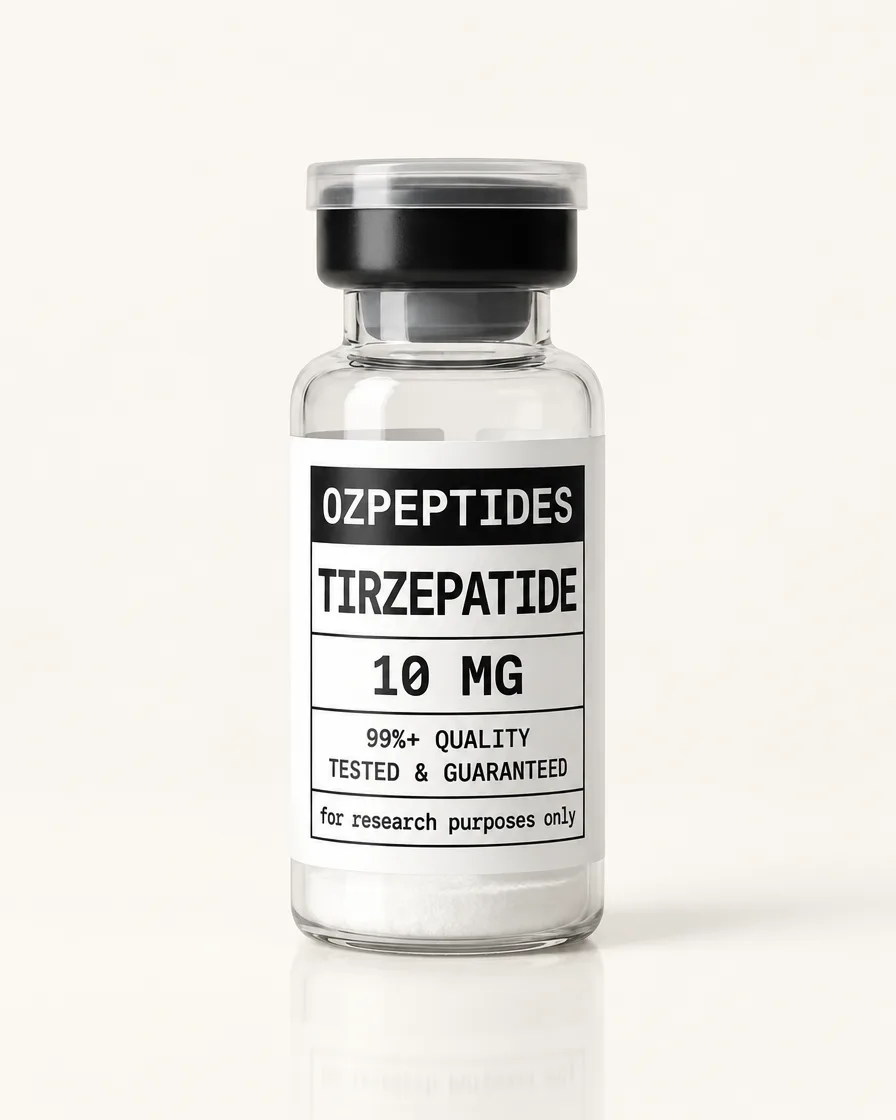
Tirzepatide is stocked in 10MG and 20MG vials. The larger vial is better value per milligram, and each strength page carries its own numbers.
Price per milligram is the comparison that matters when a compound comes in several sizes, and it is rarely linear — larger vials cost less per milligram because the synthesis, testing and fill costs are largely fixed per batch rather than per milligram. Reconstitution follows from the vial size: 10MG in 2ML of bacteriostatic water gives 5MG/ML, so a 0.1ML draw on an insulin syringe is 500mcg, while 20MG in the same 2ML gives 10MG/ML and the same draw is 1MG. That is the single most common source of error when switching between strengths, and it is why the reconstitution calculator is pre-filled per SKU rather than generic.
Why local manufacture matters for tirzepatide
An imported peptide has a longer chain between synthesis and vial, and every additional step is a place where identity, fill weight or storage conditions can go wrong.
Most research peptides sold in Australia are imported in bulk and relabelled here, which means the testing that matters happened somewhere else, if it happened at all, and the buyer is trusting a certificate they cannot trace. Making the compound locally collapses that chain: synthesis, testing and fill happen in the same facility, the certificate belongs to the batch in the vial, and there is no customs risk between the two. For a compound as widely counterfeited as tirzepatide, that is the practical argument rather than a patriotic one. We make ours in Blacktown, NSW, and dispatch from Sydney.
Tirzepatide vs semaglutide vs retatrutide
Research-grade tirzepatide, made in Australia.
Made and tested here, not relabelled from overseas: ≥99% HPLC purity, mass-spec identity, 0 ppm heavy metals, tested batch by batch.
Frequently asked
10MG and 20MG, each as a vial, pre-mixed or in a pen cartridge, with mixing at no extra cost (or $5 more per vial while a sale is running). The larger vial is better value per milligram, since synthesis, testing and fill costs are largely fixed per batch.
Yes. 10MG in 2ML is 5MG/ML; 20MG in the same 2ML is 10MG/ML, so an identical draw delivers twice as much.
It is built on the GIP sequence and modified to activate the GLP-1 receptor as well, with considerably higher affinity for GIP.
Yes, as the registered medicine Mounjaro. Research-grade material is a laboratory reagent, not that product.
Not comparable to semaglutide's SELECT trial. The SURPASS-CVOT programme addresses this; the trial record so far is SURPASS and SURMOUNT.
No. Both GIP agonism and antagonism were credible strategies in the literature, and antagonist research continued in parallel.
A synthetic peptide that activates both the GIP and GLP-1 receptors — the first dual incretin agonist to reach the market.
Tirzepatide activates two receptors, GIP and GLP-1. Retatrutide adds a third, the glucagon receptor.
In our own Australian lab, tested batch by batch before release.
- Frías JP, et al. Tirzepatide versus Semaglutide Once Weekly in Patients with Type 2 Diabetes (SURPASS-2). N Engl J Med 2021;385:503–515.
- Jastreboff AM, et al. Tirzepatide Once Weekly for the Treatment of Obesity (SURMOUNT-1). N Engl J Med 2022;387:205–216.
This guide summarises published research for educational purposes. It is not medical advice. OzPeptides products are sold for research and laboratory use only, not for human consumption. 18+ only.