Key facts
What is Semax?
Semax is a seven-amino-acid peptide: the ACTH(4-7) fragment with a proline-glycine-proline tail added for stability.
ACTH fragments were known to have behavioural effects distinct from the hormone's adrenal activity, but they degrade almost immediately. The Pro-Gly-Pro extension solves that — the same trick used in Selank — giving a peptide stable enough to study while keeping the behavioural fragment. Crucially, Semax lacks the part of ACTH that stimulates cortisol release, so it is not a corticosteroid pathway compound.
How does Semax work?
The most-reported mechanism is increased expression of BDNF and its receptor TrkB, alongside effects on monoamine systems.
Published work in rodents reports rapid increases in BDNF mRNA in the hippocampus, which is the finding most often cited as the basis for its cognitive research. Other reported activity includes modulation of dopaminergic and serotonergic signalling, and effects on the expression of genes involved in neuroinflammation after ischaemia. The proposed mechanisms are plural and none is settled.
What is Semax studied for?
Ischaemic stroke, cognitive function, attention and neuroprotection.
In Russia, Semax is registered for stroke and for cognitive indications, and clinical use there is long-standing. The published evidence is largely Russian-language and predates modern trial reporting standards, which is why it carries little weight internationally despite the volume — a limitation worth stating plainly rather than glossing. Independent replication in English-language literature is limited.
Is Semax approved in Australia?
No. It is a registered medicine in Russia but is not registered here.
An approval in one country carries no weight in another, and Semax is not registered in Australia. As a peptide with no approved human therapeutic use here, it also falls within the WADA S0 catch-all for athletes. OzPeptides supplies Semax for in-vitro and laboratory research only, 18+, not for human consumption.
How is research-grade Semax quality verified?
HPLC purity and mass-spec identity per batch, with heavy-metal screening.
Semax is sold in several variants — plain, N-acetylated, amidated — that share a name and differ in mass and behaviour. Mass spectrometry is what tells you which one is in the vial, and a purity figure alone will not. Every OzPeptides batch is made and tested here at ≥99% HPLC purity with 0 ppm heavy metals and the results recorded against that batch.
Why does Semax come from ACTH?
Because ACTH fragments were known to have behavioural effects separate from the hormone's adrenal activity. Semax is built from ACTH(4-7), which excludes the adrenal-stimulating region.
The observation that adrenocorticotropic hormone affected learning and attention independently of cortisol release goes back to mid-century work on behaviourally active peptides, and it raised an obvious question: could the behavioural fragment be separated from the hormonal one? Semax is one answer. Because it lacks the portion responsible for stimulating the adrenal cortex, it does not raise cortisol, which is the first thing anyone familiar with ACTH asks about it and the answer that makes it usable as a research tool at all.
What does the Pro-Gly-Pro tail do?
It resists enzymatic degradation. ACTH fragments are cleared almost immediately; the proline-glycine-proline extension gives a peptide stable enough to study.
Proline-rich sequences are poor substrates for many peptidases, which is why this motif appears as a stabilising strategy across several Russian-developed peptides — Selank uses the same tail on a different parent fragment. It is a simple and effective piece of design: keep the active fragment, bolt on a resistant terminus, gain a usable half-life without changing the part that does the work. Recognising the motif also helps when reading this family of compounds, since it marks them as products of one design tradition.
What is the BDNF connection?
Rodent studies report rapid increases in BDNF messenger RNA in the hippocampus, which underpins most of the cognitive and neuroprotective research.
Brain-derived neurotrophic factor supports neuron survival and synaptic plasticity, and it is the molecule most commonly invoked when a compound is described as neuroprotective. Semax's reported effect on it is rapid, which is the interesting part — transcriptional changes within an hour rather than over days. Other reported activity includes modulation of dopaminergic and serotonergic signalling and effects on genes involved in neuroinflammation after ischaemia. The proposed mechanisms are plural, and none of them is settled.
Why is the Russian literature treated cautiously?
Because much of it predates modern trial reporting standards and appears in journals that are not indexed or replicated internationally.
This is not a dismissal of Russian science, and it is worth separating the two things it could mean. The concern is methodological and practical: trials that cannot be checked — because the reporting is thin, the journal is not indexed, or no unaffiliated group has repeated the work — carry less evidential weight regardless of where they were run. The same standard applies to any literature. What it means in practice is that volume of publication is not a substitute for replication, and a compound with fifty papers from one tradition and none from outside it is not as well established as the paper count suggests.
Why the intranasal route?
Because the olfactory route can reach the central nervous system without crossing the blood-brain barrier through circulation, which matters for peptides too large to cross it easily.
Both Semax and Selank were developed as intranasal formulations and most of the published clinical work used that route. The rationale is real rather than marketing: olfactory and trigeminal pathways offer direct access to the brain, bypassing systemic circulation and hepatic clearance. Research vials are supplied lyophilised, so the route in any given study is a laboratory choice rather than something the product dictates — but published dose figures generally refer to intranasal administration, and reading them as though they applied to another route is a straightforward way to misinterpret the literature.
Is Semax prohibited in sport?
It is not currently named on the WADA Prohibited List, but it has no approval for human use outside Russia, which engages the S0 catch-all.
S0 covers pharmacological substances with no current approval by any governmental regulatory health authority for human therapeutic use and not addressed elsewhere on the list. Russian registration is the complicating factor: whether it satisfies that definition is arguable, and arguable is not a position any athlete wants to be in. The practical answer is to treat Semax as prohibited and check the current list directly rather than rely on a supplier's reading, including this one.
Which Semax is in the vial?
Semax is sold in plain, N-acetylated and amidated variants that share one name, differ in mass, and are not interchangeable.
This is the specific quality question for this compound and it cannot be answered by a purity figure — an HPLC trace reads the fraction of a single species present, not which species it is. The variants differ by modifications at the termini that change the molecular weight measurably, so mass spectrometry settles it immediately. With three products sharing a name at similar prices, identity confirmation is the check that distinguishes a supplier who tests from one who relabels.
How is Semax stored and reconstituted?
Lyophilised and cold for storage; bacteriostatic water for reconstitution, refrigerated, with a practical window of weeks.
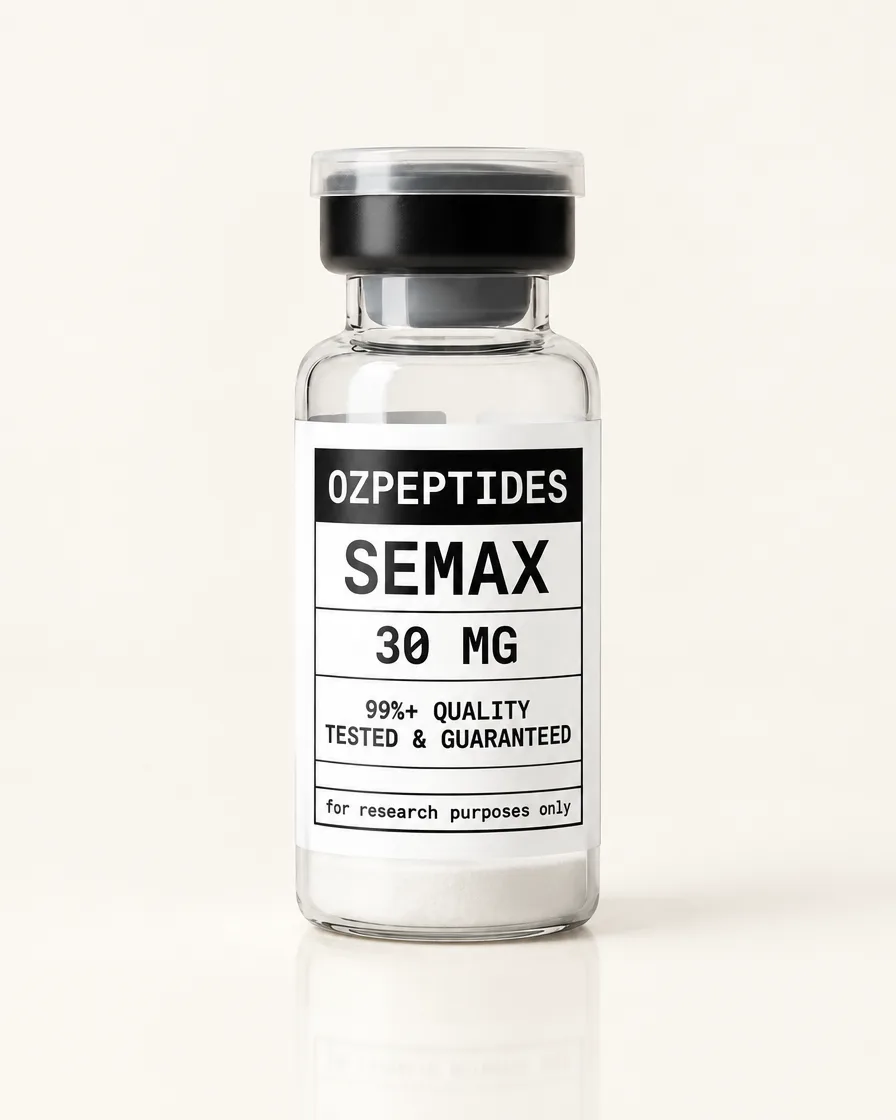
A seven-residue peptide is robust and dissolves readily. The standard rules apply: bacteriostatic water rather than sterile for a multi-draw window, diluent directed down the side of the vial, swirl rather than shake since foaming indicates denatured peptide, and refrigerate and keep out of light once mixed. We stock Semax in 5MG, 10MG and 30MG; the reconstitution calculator carries the arithmetic per strength.
Semax vs Selank vs the combined blend
Research-grade Semax, made in Australia.
Sold in three variants across the market that share one name — so we confirm the molecule by mass spec. ≥99% HPLC purity, 0 ppm heavy metals.
Frequently asked
Its documented role is resisting enzymatic degradation. The same motif appears in Selank, from the same design tradition.
Not named on the Prohibited List, but its lack of approval outside Russia arguably engages the S0 catch-all. Treat it as prohibited.
No. Plain, N-acetylated and amidated forms differ in mass and behaviour, and only mass spectrometry distinguishes them.
The olfactory route reaches the central nervous system without crossing the blood-brain barrier through circulation. Published dose figures refer to that route.
A seven-amino-acid peptide based on the ACTH(4-7) fragment with a Pro-Gly-Pro tail for stability, developed in Russia.
No. It lacks the portion of ACTH responsible for adrenal stimulation.
Rodent studies report rapid increases in BDNF expression in the hippocampus, which underpins much of the cognitive research.
Substantial in volume but largely Russian-language and predating modern trial standards. Independent replication is limited.
Semax is available in 5MG, 10MG and 30MG.
- Dolotov OV, et al. Semax, an analogue of ACTH(4-7), regulates expression of immediate early genes and brain-derived neurotrophic factor in rat hippocampus. J Neurochem 2006;97:82–86.
- Gusev EI, et al. Semax in acute ischemic stroke: a randomized, placebo-controlled study. Zh Nevrol Psikhiatr 2005;105:3–10.
This guide summarises published research for educational purposes. It is not medical advice. OzPeptides products are sold for research and laboratory use only, not for human consumption. 18+ only.