Key facts
What is Selank?
Selank is a seven-residue peptide built from tuftsin, a fragment of the immunoglobulin heavy chain, plus a proline-glycine-proline tail.
Tuftsin itself is a four-amino-acid peptide with documented immune-modulating activity, and it was an odd starting point for a compound now studied mainly for anxiety. The same Russian group behind Semax added the Pro-Gly-Pro tail to give it usable stability. The two compounds share that design and are frequently studied and sold together.
How does Selank work?
Published work reports effects on GABA-A receptor expression and on serotonin metabolism, plus changes in BDNF expression.
The anxiolytic research describes activity through GABAergic signalling without the sedation or dependence associated with benzodiazepines — which is the claim that attracted attention, and also the one needing independent confirmation. Studies also report effects on enkephalin degradation and on the expression of genes involved in monoamine metabolism. As with Semax, no single mechanism is established.
What is Selank studied for?
Generalised anxiety, stress models, and cognitive performance under stress.
Russian clinical work covers generalised anxiety disorder, including comparisons against benzodiazepines, alongside rodent models of stress and anxiety. There is also published work on immune parameters, reflecting its tuftsin origin. The evidence base carries the same limitation as Semax: substantial in Russia, thin in independent international literature.
Is Selank approved in Australia?
No. It is registered in Russia and is not registered here.
Selank is not a registered medicine in Australia. It also falls within the WADA S0 catch-all for athletes, as a peptide with no approved human therapeutic use here. OzPeptides supplies Selank for in-vitro and laboratory research only, 18+, not for human consumption.
How is research-grade Selank quality verified?
HPLC purity, mass-spec identity, heavy-metal screening.
Selank is also sold in an amidated variant, so identity confirmation matters for the same reason it does with Semax: the name on the label does not settle which molecule is inside. Our batches are made and tested in Australia at ≥99% HPLC purity with 0 ppm heavy metals, results recorded against the batch on your vial.
What is tuftsin, and why build on it?
Tuftsin is a four-amino-acid fragment of the antibody immunoglobulin G, with documented immunomodulatory activity. Selank is tuftsin with a Pro-Gly-Pro stabilising tail.
The choice of parent fragment is what makes Selank different in kind from Semax. Tuftsin comes from the immune system rather than the endocrine one, and its known activity concerns phagocyte stimulation. Building an anxiolytic research compound on an immune fragment is an unusual move, and it is part of why Selank's reported mechanisms span both neurotransmitter systems and immune signalling — including effects on interleukin expression alongside the GABAergic and serotonergic work.
How is Selank reported to work?
Through GABAergic and serotonergic signalling, with reported effects on BDNF expression and on the enkephalin-degrading enzymes.
The anxiolytic framing rests mainly on the GABA work, which is the system benzodiazepines act on — though Selank is not a benzodiazepine and is not reported to bind that site. Serotonin metabolism effects appear in the rodent literature, as do changes in the expression of genes related to neuroinflammation. The reported inhibition of enkephalin degradation is the least discussed and arguably the most interesting, since it would extend endogenous opioid signalling without an exogenous opioid. As with Semax, the mechanisms are plural and none is settled.
How does Selank differ from Semax?
Different parent fragment, different research focus. Semax is built from ACTH(4-7) and studied for cognition and neuroprotection; Selank from tuftsin and studied for anxiety.
They share the Pro-Gly-Pro stabilising motif and the same research tradition, which is why they are so often discussed together and sold as a blend. The overlap is real — both report BDNF effects — but the emphases differ, and so do the parent molecules: one from a pituitary hormone, one from an antibody. Anyone treating them as interchangeable is ignoring the more informative half of the comparison.
Why is the Russian literature treated cautiously?
Because much of it predates modern trial reporting standards and appears in journals that are not indexed or replicated internationally.
This is not a dismissal of Russian science, and it is worth separating the two things it could mean. The concern is methodological and practical: trials that cannot be checked — because the reporting is thin, the journal is not indexed, or no unaffiliated group has repeated the work — carry less evidential weight regardless of where they were run. The same standard applies to any literature. What it means in practice is that volume of publication is not a substitute for replication, and a compound with fifty papers from one tradition and none from outside it is not as well established as the paper count suggests.
Why the intranasal route?
Because the olfactory route can reach the central nervous system without crossing the blood-brain barrier through circulation, which matters for peptides too large to cross it easily.
Both Semax and Selank were developed as intranasal formulations and most of the published clinical work used that route. The rationale is real rather than marketing: olfactory and trigeminal pathways offer direct access to the brain, bypassing systemic circulation and hepatic clearance. Research vials are supplied lyophilised, so the route in any given study is a laboratory choice rather than something the product dictates — but published dose figures generally refer to intranasal administration, and reading them as though they applied to another route is a straightforward way to misinterpret the literature.
Is Selank prohibited in sport?
It is not currently named on the WADA Prohibited List. Its lack of approval outside Russia means the S0 catch-all is arguable.
As with Semax, Russian registration complicates a clean answer, and an arguable position is a poor one for an athlete. Anti-doping rules also concern the source and form of anything administered, and research-grade material is not a medicine and carries no therapeutic use exemption pathway. Check the current list directly rather than relying on a supplier's summary.
Which Selank is in the vial?
Selank is sold in plain and amidated forms, which differ in mass and are not interchangeable — N-acetyl Selank amidate is a distinct product.
The same identity problem as Semax, and the same answer: a purity figure cannot tell you which variant is present, because purity measures the fraction of a single species rather than its identity. Mass spectrometry resolves it. With several products sharing a name at similar prices, that confirmation is what distinguishes a supplier who tests from one who relabels imported stock.
How is Selank stored and reconstituted?
Lyophilised and cold for storage; bacteriostatic water for reconstitution, refrigerated, with a practical window of weeks.
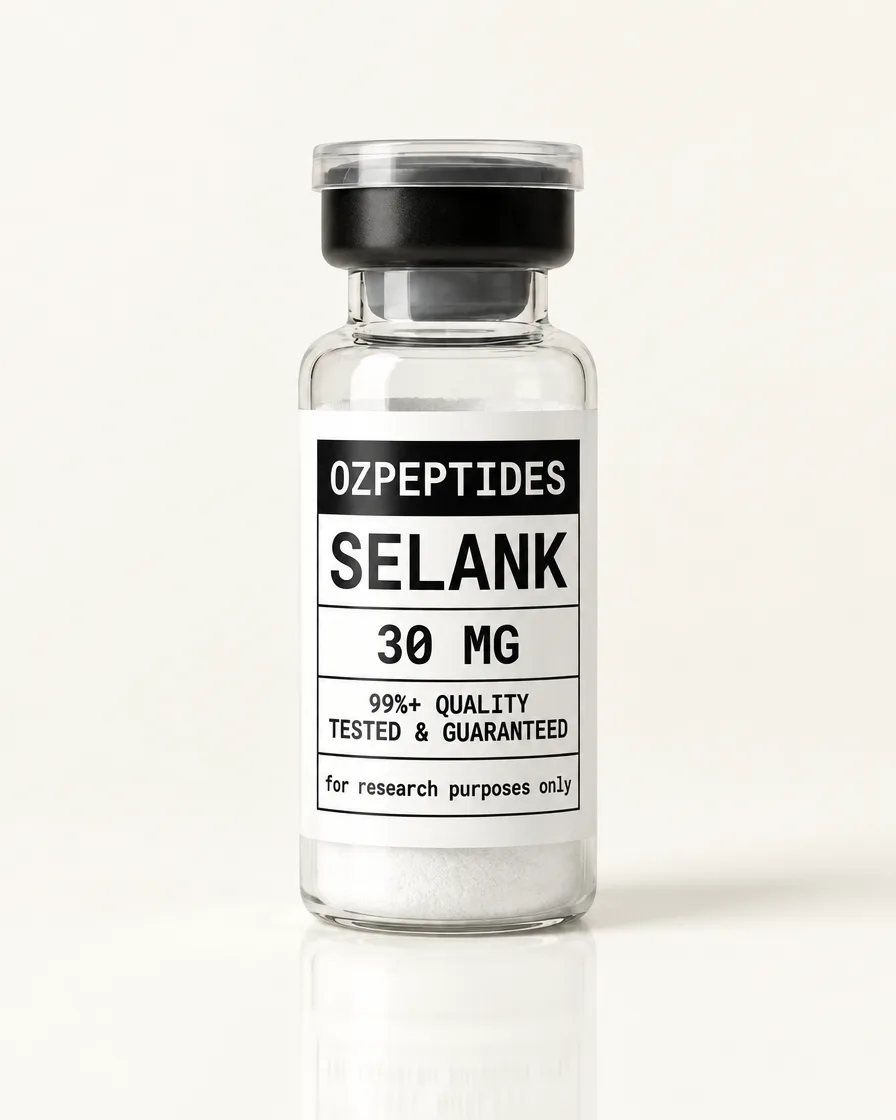
A seven-residue peptide dissolves readily and needs no special handling. The standard rules apply: bacteriostatic water rather than sterile for a multi-draw window, diluent directed down the side of the vial, swirl rather than shake, and refrigerate and keep out of light once mixed. We stock Selank in 10MG and 30MG; the reconstitution calculator carries the arithmetic per strength.
Research-grade Selank, made in Australia.
Made and tested here, identity confirmed so the variant is not a guess: ≥99% HPLC purity, 0 ppm heavy metals, tested batch by batch.
Frequently asked
Tuftsin, a four-amino-acid fragment of immunoglobulin G, with a Pro-Gly-Pro tail added for stability.
No. The anxiolytic research concerns GABAergic signalling, but Selank is not reported to bind the benzodiazepine site.
Different parent fragment and different research emphasis — tuftsin and anxiety against ACTH(4-7) and cognition — though both report BDNF effects.
No. Plain and amidated forms differ in mass and are distinct products, distinguishable only by mass spectrometry.
A synthetic analogue of tuftsin with a Pro-Gly-Pro stabilising tail, studied mainly for anxiety.
A four-amino-acid immune-modulating peptide derived from the immunoglobulin heavy chain — Selank's starting point.
Mostly Russian-language clinical work with limited independent replication.
Selank is available in 10MG and 30MG.
- Zozulya AA, et al. The efficacy of Selank in anxious-asthenic disorders. Zh Nevrol Psikhiatr 2008;108:38–48.
- Volkova A, et al. Selank administration attenuates stress-induced anxiety in rats. Front Pharmacol 2016;7:31.
This guide summarises published research for educational purposes. It is not medical advice. OzPeptides products are sold for research and laboratory use only, not for human consumption. 18+ only.