Key facts
What is DSIP?
DSIP is a nonapeptide identified during experiments looking for a circulating factor that induced sleep.
The original work involved perfusing blood from sleeping rabbits into wakeful ones and isolating the fraction associated with delta-wave sleep. The peptide found was named for that observation. Half a century later, no receptor has been definitively identified for it, and whether it functions as an endogenous sleep regulator remains unsettled — an unusual position for a compound this old.
How does DSIP work?
No specific receptor has been established. Reported effects span sleep architecture, stress hormones and pain modulation.
Published work describes effects on delta-wave sleep in some models and not others, along with reports of interaction with opioid systems, modulation of ACTH and corticosteroid release, and antioxidant activity. The breadth of proposed activity with no identified target is itself informative: it suggests either a genuinely pleiotropic signalling role or a compound whose reported effects have not been cleanly separated from experimental variation.
What is DSIP studied for?
Sleep research, stress hormone regulation, and chronic pain models.
Small human studies from the 1980s reported effects in insomnia and in narcolepsy, with results that were not consistently replicated. Later work has looked at alcohol and opiate withdrawal models and at chronic pain. The literature is old, sparse, and mostly predates modern methodology, so DSIP is best described as a historically interesting compound with an unresolved evidence base.
Is DSIP approved in Australia?
No. It has never been registered as a medicine anywhere.
DSIP is not registered in Australia, and as a peptide with no approved human therapeutic use it falls within the WADA S0 catch-all for athletes. OzPeptides supplies it for in-vitro and laboratory research only, 18+, not for human consumption.
How is research-grade DSIP quality verified?
HPLC purity and mass-spec identity per batch, plus heavy-metal screening.
DSIP is a simple nine-residue sequence with no unusual residues or modifications, so a well-made batch should test very clean. Our batches are made and tested in our Australian lab at ≥99% HPLC purity with 0 ppm heavy metals, and the batch number on your vial is what those results are recorded against.
Where did DSIP come from?
From Schoenenberger and Monnier's work in Switzerland in the 1970s, isolating a factor from the cerebral venous blood of rabbits in induced slow-wave sleep.
The experimental design is the memorable part: blood taken from animals in a specific sleep state, fractionated, and tested for the ability to induce the same state in recipients. That is a classic transfer experiment, and it produced a nine-amino-acid peptide named for what it was thought to do. Delta-wave sleep is the deep, slow-wave stage, and the name has stuck for fifty years — which is unfortunate, because the sleep-inducing activity is the part that held up least well.
Does DSIP actually induce sleep?
The evidence is inconsistent. Later work frequently failed to reproduce the original sleep-promoting findings, and the peptide's name outlived its demonstrated function.
This is the honest centre of the DSIP story and the reason it is a cautionary example rather than a promising compound. Subsequent studies produced mixed and often negative results, and no coherent mechanism emerged. Research attention drifted to other reported activities — effects on stress responses, on hormone secretion, on nociception — none of which consolidated into an established function either. A peptide named for an effect it may not reliably produce is an unusual object, and saying so is more useful than repeating the name as though it were a description.
Is there a known DSIP receptor?
No. No receptor has been identified, and the peptide's endogenous role, if it has one, remains undefined.
Fifty years without an identified target is a long time, and it distinguishes DSIP from compounds where mechanism is merely incomplete. Reports of its presence in human tissue and plasma exist, but its physiological function has not been established. That absence is not proof it does nothing — plenty of biology remains undescribed — but it does mean any specific mechanistic claim about DSIP is an extrapolation rather than a finding.
What is DSIP used for in research now?
Mainly as a subject in its own right: a well-known peptide with an unresolved function, studied in sleep, stress and neuroendocrine contexts.
Compounds with unsettled biology are legitimate research subjects, and DSIP appears in work on stress hormone responses, on opioid withdrawal models and on circadian biology. What it is not is an established sleep agent. The useful framing for anyone considering it is that it is a tool for asking questions rather than a compound with answers attached, which is an unglamorous but accurate position.
Is DSIP prohibited in sport?
It has no approval for human therapeutic use anywhere, which places it under the WADA S0 catch-all.
S0 covers pharmacological substances with no current approval by any governmental regulatory health authority for human use and not addressed elsewhere on the Prohibited List. DSIP has no such approval in any jurisdiction, so athletes subject to anti-doping rules should treat it as prohibited at all times, in and out of competition.
What is DSIP's status in Australia?
Not registered in Australia. It is supplied for in-vitro and laboratory research only, to buyers aged 18 and over.
DSIP has never been assessed for use in Australia, and there is no approved product containing it anywhere in the world. That is worth stating plainly for a compound whose familiar name can imply a standing it does not have — being well known for five decades is not the same as being established, and in DSIP's case the two have diverged considerably.
How is DSIP stored and reconstituted?
Lyophilised and cold for storage; bacteriostatic water for reconstitution, refrigerated, with a practical window of weeks.
Bacteriostatic water rather than sterile water is what makes a multi-draw vial possible, since the benzyl alcohol in it inhibits bacterial growth where sterile water offers no protection. Direct the diluent down the side of the vial and swirl rather than shake: foaming is a reliable sign of denatured peptide. Keep the reconstituted vial refrigerated and out of light. The reconstitution calculator is pre-filled per SKU, so the concentration and the units on a standard insulin syringe come from the vial in hand rather than a generic worked example.
What should be checked in a DSIP vial?
Identity by mass spectrometry and purity by HPLC. A nine-residue peptide is cheap to synthesise well, so a genuine batch should test very clean.
The corollary is that a mediocre purity figure on a compound this simple says something about the supplier rather than about the chemistry. With little economic incentive to adulterate something inexpensive, the realistic failure mode is underfilling — a vial containing a fraction of its stated weight, which passes purity testing without difficulty because purity measures the fraction of what is present rather than how much is there. We make DSIP in Blacktown, NSW, at ≥99% HPLC purity with 0 ppm heavy metals.
Why the name is worth being careful with
Because "delta sleep-inducing peptide" states a function the evidence does not support, and the name is quoted as though it were a description.
This is a small case study in how research vocabulary hardens. A compound isolated in a sleep-transfer experiment was named for the effect it was thought to produce, the effect largely failed replication, and the name survived intact into every catalogue and forum discussion since. Anyone encountering DSIP for the first time reasonably assumes the name describes what it does. It does not describe what it does; it describes what a 1970s experiment suggested it might do. Holding that distinction is the single most useful thing to carry into any reading about this compound, and it generalises: several peptides in this catalogue carry names asserting mechanisms or effects that are proposed rather than established, and a name is not a citation.
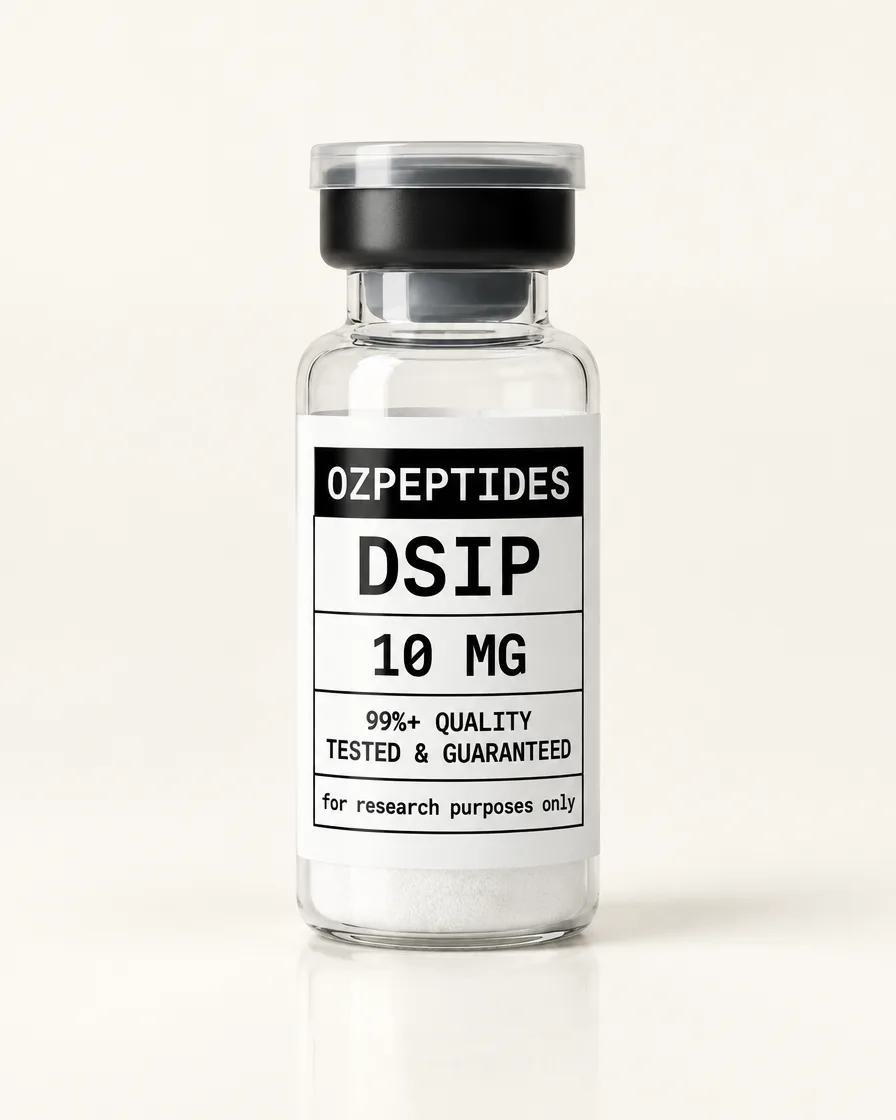
Research-grade DSIP, made in Australia.
A simple sequence that should test clean, and does: ≥99% HPLC purity, confirmed identity, 0 ppm heavy metals, tested batch by batch.
Frequently asked
No. It describes what a 1970s transfer experiment suggested it might do. The sleep effect largely failed replication, and the name outlived it.
No. Later work frequently failed to reproduce the original findings, and the name has outlived the demonstrated effect.
None has been identified in fifty years, and the peptide's endogenous role remains undefined.
By transferring cerebral venous blood from rabbits in induced slow-wave sleep and fractionating it, in Switzerland in the 1970s.
No. It has no approval in any jurisdiction, Australia included.
Delta sleep-inducing peptide — a nine-amino-acid peptide isolated in 1977 from research into sleep-promoting factors.
Mostly from the 1980s and 90s, predating modern trial standards.
DSIP is available in 10MG.
- Schoenenberger GA, Monnier M. Isolation and characterization of a humoral sleep-inducing factor (delta sleep-inducing peptide). Proc Natl Acad Sci USA 1977;74:1282–1286.
- Graf MV, Kastin AJ. Delta-sleep-inducing peptide (DSIP): a review. Neurosci Biobehav Rev 1984;8:83–93.
This guide summarises published research for educational purposes. It is not medical advice. OzPeptides products are sold for research and laboratory use only, not for human consumption. 18+ only.