Key facts
What is oxytocin?
Oxytocin is a small human hormone, nine amino acids with an internal disulfide bridge, released from the posterior pituitary.
It differs from vasopressin by only two residues, which is why the two hormones cross-react at each other's receptors and why selectivity is a recurring issue in the research. Synthesised commercially since the 1950s — the work that earned du Vigneaud a Nobel Prize — it was among the first peptide hormones ever made in a lab.
How does oxytocin work?
It acts on the oxytocin receptor, a G-protein coupled receptor found in uterine and mammary tissue and in several brain regions.
Peripheral actions are well established: uterine contraction during labour and milk ejection during nursing. Central actions are the contested part. Receptor distribution in the brain includes regions involved in social and emotional processing, but how much intranasally administered oxytocin actually reaches those regions is genuinely disputed, and that uncertainty sits underneath a great deal of the published social-cognition work.
What is oxytocin studied for?
Labour and lactation clinically; social cognition, trust and autism research experimentally.
The clinical uses are long established. The experimental literature on social behaviour grew rapidly from the 2000s and has since been tempered: several high-profile findings failed to replicate, and methodological critiques of intranasal delivery and small sample sizes are substantial. Trials in autism have largely not shown the benefits early work suggested. It is a good example of a field correcting itself.
Is oxytocin approved in Australia?
Yes, as a prescription medicine for obstetric use. Research-grade oxytocin is not that product.
Registered oxytocin injections are registered in Australia and used in hospitals. A research-grade lyophilised vial is a laboratory reagent, not a medicine, and is not interchangeable with a registered product under any circumstances. OzPeptides supplies oxytocin for in-vitro and laboratory research only, 18+, not for human consumption.
How is research-grade oxytocin quality verified?
HPLC purity, mass-spec identity confirmation, heavy-metal screening.
The disulfide bridge is part of oxytocin's identity: a reduced, open-chain version has the same residues, a different mass and different activity. Mass spectrometry confirms the cyclic form. Every batch is made and tested in our Australian lab at ≥99% HPLC purity with 0 ppm heavy metals and the results recorded against the batch.
What is oxytocin?
A nine-amino-acid hormone made in the hypothalamus and released from the posterior pituitary, with established roles in labour and lactation and a large literature on social behaviour.
Oxytocin is one of the best-characterised peptides in biology and among the first ever sequenced and synthesised — du Vigneaud won the Nobel Prize in Chemistry in 1955 for that work. Its structure includes a disulfide bridge forming a six-residue ring with a three-residue tail, and it differs from vasopressin by only two amino acids, which is why the two show cross-reactivity at each other's receptors. That closeness is a recurring complication in interpreting oxytocin research.
Is oxytocin an approved medicine?
Yes. Synthetic oxytocin is registered in Australia and worldwide, used in obstetrics to induce or augment labour and to control postpartum haemorrhage.
That makes it unusual in this catalogue: an established, regulated therapeutic with decades of clinical use and a well-understood safety profile in its approved indications. A registered product is a specific formulation made to pharmaceutical standards with a regulator behind each batch. Research-grade material is a laboratory reagent and is not that product, is not supplied for human use, and is not a substitute for a prescription medicine.
Why does the similarity to vasopressin matter?
Because they differ by two amino acids and cross-react at each other's receptors, which confounds the interpretation of any effect attributed to oxytocin alone.
Vasopressin governs water retention and blood pressure, and it has its own social-behaviour literature. At the doses used in some studies, oxytocin activity at vasopressin receptors is a live possibility, and disentangling the two requires selective ligands and careful controls that not all published work employs. It is also a practical identity issue: two nine-residue peptides differing by two residues are distinguishable by mass spectrometry and not by appearance or purity figures.
Is oxytocin prohibited in sport?
It is not currently on the WADA Prohibited List. Vasopressin and its analogues are listed under S5 as masking agents, which is a related but separate matter.
The S5 listing for vasopressin relates to its effect on fluid balance and its potential to alter urine concentration. Oxytocin is not named. As always the list is revised annually and should be checked directly, and research-grade material carries no therapeutic use exemption pathway regardless of a substance's listing status.
How is oxytocin stored and reconstituted?
Lyophilised and cold for storage. Oxytocin is less stable in solution than many peptides, so a reconstituted vial should be kept cold and dark and used within a shorter window.
The disulfide bridge is the vulnerability: it can be reduced or scrambled, which changes the molecule without changing its mass in a way that is obvious. That makes oxytocin more sensitive to storage conditions than a simple linear peptide, and it is a genuine constraint rather than boilerplate caution. Bacteriostatic water is still the appropriate diluent for a multi-draw vial, and the usual swirl-not-shake handling applies.
What should be checked in an oxytocin vial?
Identity by mass spectrometry, purity by HPLC and fill weight, with attention to the disulfide bridge being intact rather than reduced.
A reduced or scrambled disulfide gives a molecule with the same amino acid composition and different behaviour, which is a subtler failure than substitution and needs the right assay to detect. The similarity to vasopressin is the other identity question. We make oxytocin in Blacktown, NSW, at ≥99% HPLC purity with 0 ppm heavy metals, and supply it for in-vitro and laboratory research only.
Why is oxytocin historically important?
It was among the first peptide hormones to be sequenced and chemically synthesised, work that established that peptide hormones could be made in a laboratory at all.
Vincent du Vigneaud's synthesis in the early 1950s proved the principle underlying every compound in this catalogue: that a biologically active peptide hormone can be assembled chemically and will behave like the natural molecule. Before that, hormones meant extraction from tissue. Everything about modern peptide research — solid-phase synthesis, defined analogues, structure-activity studies — descends from that demonstration, which makes oxytocin the ancestor of the entire field.
Research-grade oxytocin, made in Australia.
The disulfide bridge is the molecule, so we confirm it by mass spec: ≥99% HPLC purity, 0 ppm heavy metals, tested batch by batch.
Frequently asked
Yes. Synthetic oxytocin is registered in Australia and worldwide for obstetric use. Research-grade material is not that product.
Less so than its reputation. The intranasal social-behaviour literature has well-documented replication problems and an unresolved delivery question, and trials in autism have largely not confirmed early promise.
By two amino acids. They cross-react at each other's receptors, which confounds interpretation and makes identity testing important.
It was among the first peptide hormones sequenced and chemically synthesised, in work that won du Vigneaud the 1955 Nobel Prize in Chemistry.
A nine-amino-acid hormone produced in the hypothalamus, involved in labour, lactation and social behaviour research.
It is disputed. How much crosses to central targets is a live methodological question in the literature.
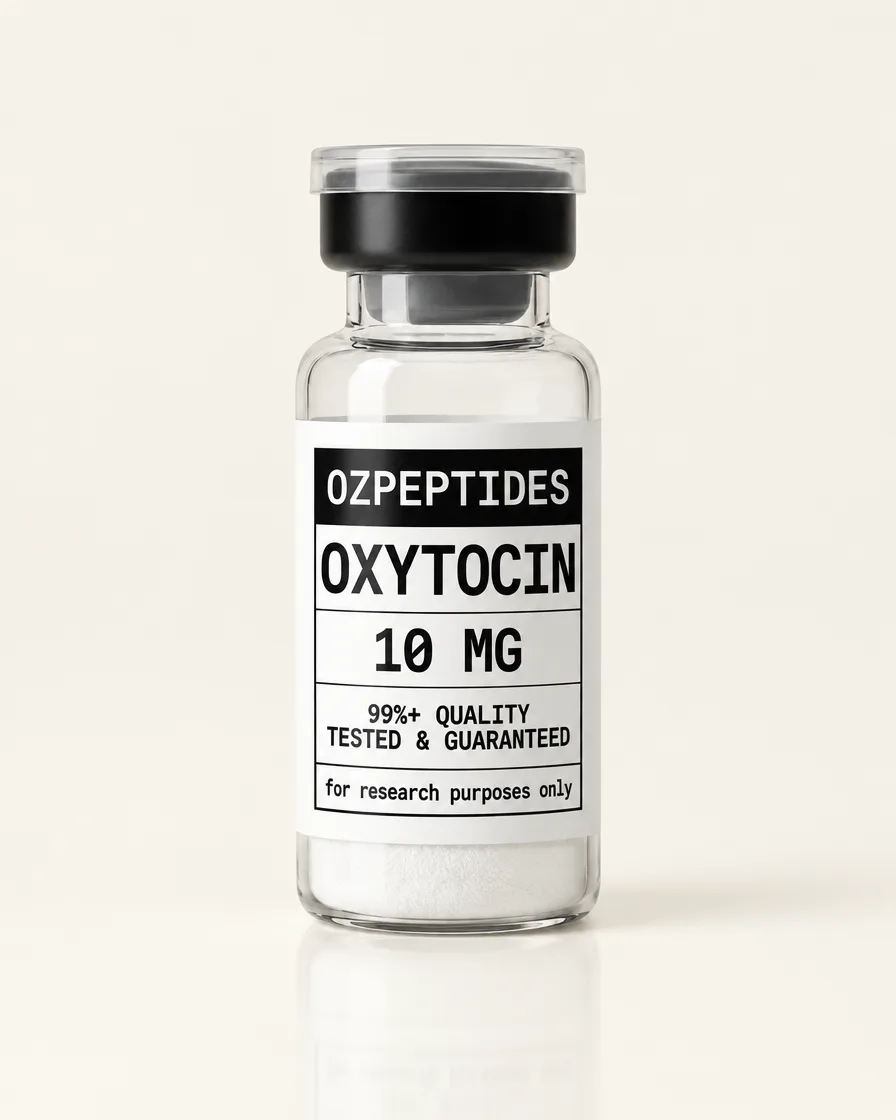
Oxytocin is available in 10MG.
- du Vigneaud V, et al. The synthesis of an octapeptide amide with the hormonal activity of oxytocin. J Am Chem Soc 1953;75:4879–4880.
- Leng G, Ludwig M. Intranasal oxytocin: myths and delusions. Biol Psychiatry 2016;79:243–250.
This guide summarises published research for educational purposes. It is not medical advice. OzPeptides products are sold for research and laboratory use only, not for human consumption. 18+ only.
What about the social behaviour research?
It is large, influential and considerably less robust than its popular reputation. Replication problems in the intranasal oxytocin literature are well documented.
The "love hormone" framing came from a body of work reporting effects on trust, empathy and social cognition after intranasal administration. That literature has been subject to serious methodological criticism: small samples, publication bias, and failed replications of headline findings. There is also an unresolved question about whether intranasally administered oxytocin reaches the brain in meaningful quantities at all. None of this makes the underlying biology uninteresting — endogenous oxytocin signalling in social behaviour is real — but the administration studies are much weaker than the coverage suggests.