Key facts
What is SNAP-8?
SNAP-8 is an eight-residue acetylated peptide developed for topical cosmetic use, extending the six-residue Argireline sequence by two amino acids.
Both peptides derive from the N-terminal sequence of SNAP-25, a protein in the SNARE complex that mediates vesicle fusion during neurotransmitter release. SNAP-8 is the longer version, marketed on the basis that the extension improves its interaction with the complex. In cosmetic formulation it is a straightforward, water-soluble ingredient, which is part of its appeal — many peptides are not.
How does SNAP-8 work?
The proposed mechanism is competition with SNAP-25 for a position in the SNARE complex, which in theory reduces vesicle fusion and neurotransmitter release.
The SNARE complex assembles to fuse acetylcholine-containing vesicles with the membrane at the neuromuscular junction. A peptide that mimics part of SNAP-25 could, in principle, destabilise that assembly. The comparison sometimes drawn with botulinum toxin is a comparison of proposed mechanism only — the scale of effect is not remotely equivalent, and published independent evidence for topical peptides of this class is modest.
What is SNAP-8 studied for?
Topical cosmetic research on expression lines.
Most of the available data comes from manufacturer studies of topical formulations, with independent peer-reviewed work on this specific peptide thin on the ground. It is widely used as a formulation ingredient rather than as a subject of academic research — and a research guide should say that plainly rather than dress up supplier literature as evidence.
Is SNAP-8 approved in Australia?
It is used as a cosmetic ingredient here; our research-grade material is not a cosmetic product.
Acetyl octapeptide-3 appears in cosmetic products regulated under Australian industrial chemicals rules. That is not a therapeutic approval, and it does not apply to a lyophilised research vial. OzPeptides supplies SNAP-8 for in-vitro and laboratory research only, 18+, not for human consumption.
How is research-grade SNAP-8 quality verified?
HPLC purity, mass-spec identity confirmation, heavy-metal screening.
Because SNAP-8 and Argireline are closely related sequences of different lengths, identity confirmation is the test that matters most: they are not interchangeable, and a supplier substituting one for the other would not be obvious from appearance or basic assay. Every OzPeptides batch is made and tested here at ≥99% HPLC purity with 0 ppm heavy metals and the results recorded against the batch.
What is SNAP-8?
An eight-amino-acid peptide, an elongated version of the better-known Argireline (acetyl hexapeptide-8), developed as a topical cosmetic ingredient.
SNAP-8 stands for Synake-like peptide, and it belongs to a small family of cosmetic peptides designed around the SNARE complex rather than around any hormone or growth factor. It is important to be clear about category: this is a cosmetic ingredient with a cosmetic research record, not a therapeutic peptide with a clinical programme. That makes it unusual in this catalogue, where most compounds come out of pharmaceutical research, and it changes what the available evidence looks like.
How is SNAP-8 reported to work?
By interfering with SNARE complex formation, the machinery that lets vesicles fuse with the cell membrane to release neurotransmitter.
Muscle contraction at a neuromuscular junction requires acetylcholine release, and release requires vesicles to dock and fuse with the membrane — a process driven by the SNARE proteins SNAP-25, syntaxin and VAMP. SNAP-8 mimics the N-terminal end of SNAP-25 and is proposed to compete for a place in the complex, reducing the efficiency of fusion. It is the same general premise as botulinum toxin approaches from an entirely different direction, and it is worth noting that a topical peptide competing in an intracellular protein complex faces a substantial delivery problem before any of that applies.
How strong is the SNAP-8 evidence?
It is cosmetic-industry evidence: supplier-run studies and in-vitro work, not independent peer-reviewed clinical trials.
This is the honest framing and it is not a dismissal — cosmetic ingredients are assessed on a different basis from medicines, and the studies behind them are typically small, sponsor-run and focused on measurable skin parameters. What that means practically is that claims about SNAP-8 rest on a narrower and less independent evidence base than claims about, say, GHK-Cu. The delivery question in particular — whether a peptide applied to intact skin reaches the neuromuscular junction at all — is the one the literature addresses least convincingly.
How does SNAP-8 differ from Argireline?
SNAP-8 is two residues longer. It was developed as an extension of the acetyl hexapeptide sequence, on the premise that the longer peptide competes more effectively.
Argireline came first and remains the more widely used of the two. SNAP-8 is the elongated variant, marketed on the basis of improved activity in the same mechanism. Whether the extra length delivers a real difference is not settled by independent work, and the two are frequently formulated together. For anyone evaluating them, the useful distinction is the sequence and the mass — which is a matter of identity confirmation, not of marketing claims.
Is SNAP-8 used topically or otherwise?
Topically. It was developed as a cosmetic ingredient for formulation into creams and serums, and that is the context all of its research sits in.
This matters because SNAP-8 is sometimes sold alongside injectable research peptides without the route being made clear, and a compound whose entire evidence base is topical formulation does not become a systemic research compound by being put in a vial. As with every peptide on this site, ours is supplied for in-vitro and laboratory research only. The research context for SNAP-8 specifically is formulation and skin-model work.
How is SNAP-8 stored and handled?
Lyophilised and cold for storage. Once in solution it should be kept refrigerated, and it is typically incorporated into a formulation rather than stored long in water.
Cosmetic peptides are usually supplied to formulators as powders or concentrated solutions and blended into a finished product with its own preservative system, which is a different storage problem from a multi-draw vial. For laboratory work the standard rules apply: keep the powder cold and dry, reconstitute with an appropriate diluent, avoid shaking, and keep the solution refrigerated and out of light.
What should be checked in a SNAP-8 vial?
Identity by mass spectrometry and purity by HPLC. SNAP-8 and Argireline are close relatives sold under overlapping names, so identity is the check that matters.
Acetyl octapeptide and acetyl hexapeptide differ by two residues and therefore by a clear mass, which mass spectrometry resolves and a purity figure does not. Cosmetic peptides are also commonly sold as dilute solutions with the peptide making up a small fraction of the stated weight, so what the milligram figure refers to is worth establishing. We make SNAP-8 in Blacktown, NSW, at ≥99% HPLC purity with 0 ppm heavy metals, and the figure on the vial is peptide weight.
The delivery problem, stated plainly
A peptide applied to intact skin has to cross the stratum corneum to reach anything, and eight-residue peptides are poor candidates for that.
This is the weakest link in the SNAP-8 story and the one cosmetic marketing addresses least. The stratum corneum is an effective barrier, and permeation generally favours small, lipophilic molecules — a charged octapeptide is neither. The proposed mechanism also requires the peptide to reach an intracellular protein complex at the neuromuscular junction, which is deeper still. Formulation science has answers it deploys here: penetration enhancers, liposomal carriers, occlusion. Whether any of them deliver enough intact peptide to the right compartment to matter is the question the independent literature does not settle, and it is a more useful thing to know about SNAP-8 than any claim about its mechanism. None of this makes the compound uninteresting as a formulation research subject; it does mean the mechanism and the outcome are separated by a step that has not been demonstrated.
Research-grade SNAP-8, made in Australia.
Identity confirmed by mass spec, so you get acetyl octapeptide-3 and not its shorter cousin. ≥99% HPLC purity, 0 ppm heavy metals, tested batch by batch.
Frequently asked
That is the unsettled question. A charged octapeptide is a poor candidate for crossing the stratum corneum, and the independent literature does not resolve it.
It is proposed to interfere with SNARE complex formation, the machinery that lets vesicles fuse and release neurotransmitter.
SNAP-8 is the eight-residue elongation of the acetyl hexapeptide sequence, marketed on the premise that the longer peptide competes more effectively.
Not of substance. The record is cosmetic-industry studies and in-vitro work rather than independent peer-reviewed trials.
Yes. It was developed for formulation into cosmetic products, and all of its research sits in that context.
Acetyl octapeptide-3, an eight-amino-acid cosmetic peptide related to the Argireline sequence.
Only as a proposed mechanism on paper. The comparison should not be read as equivalence of effect.
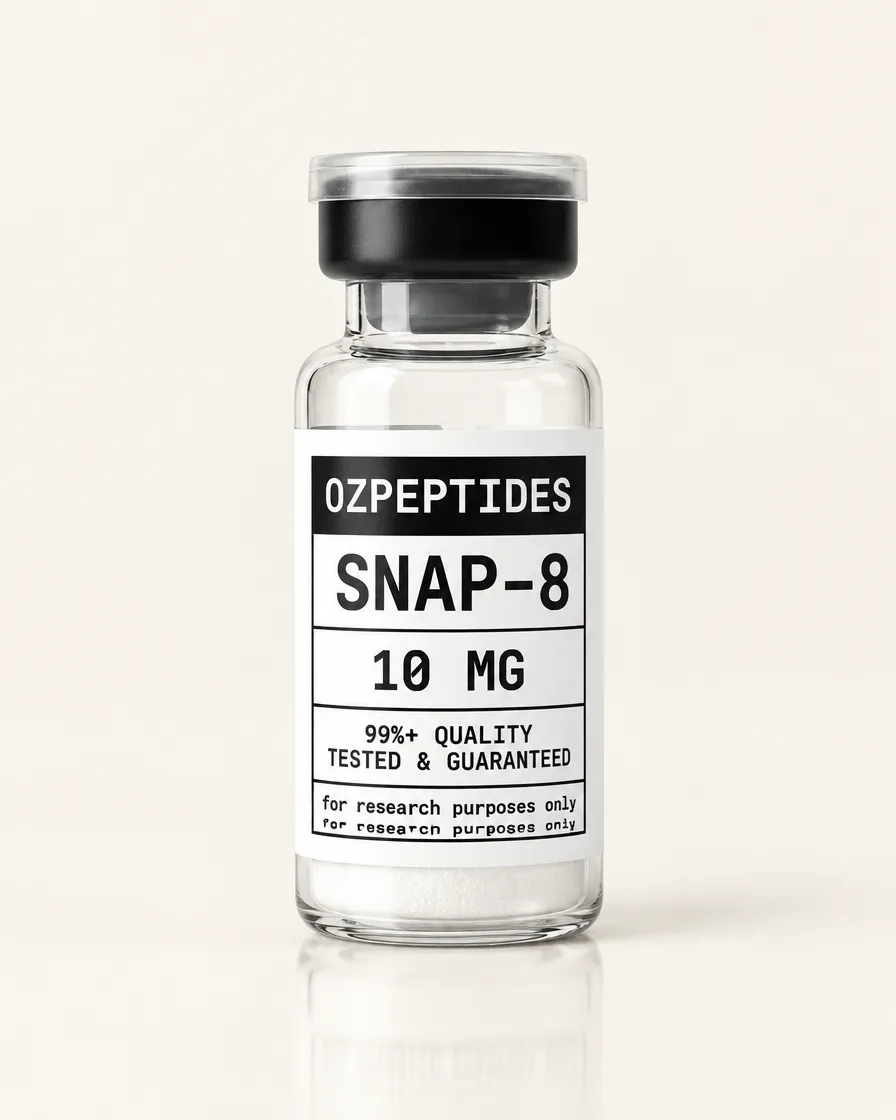
SNAP-8 is available in 10MG.
- Blanes-Mira C, et al. A synthetic hexapeptide (Argireline) with antiwrinkle activity. Int J Cosmet Sci 2002;24:303–310.
- Lim SH, et al. Cosmeceutical peptides: an overview of mechanisms and applications. Int J Mol Sci 2018;19:3550.
This guide summarises published research for educational purposes. It is not medical advice. OzPeptides products are sold for research and laboratory use only, not for human consumption. 18+ only.