Key facts
What is HCG?
HCG is a two-subunit glycoprotein hormone produced by the placenta, considerably larger and more complex than the peptides in the rest of this range.
It shares an identical alpha subunit with LH, FSH and TSH; the beta subunit is what makes it HCG, and it carries substantial carbohydrate modification. That glycosylation is functional, not decorative — it is why HCG circulates far longer than LH. Being a glycoprotein rather than a simple peptide, it is measured in international units of biological activity instead of by weight, which is why our strengths read 2000IU rather than milligrams.
How does HCG work?
It binds the LH/CG receptor, so tissues that respond to luteinising hormone respond to HCG as well — with a much longer duration.
In the ovary that means triggering ovulation; in the testis it means stimulating Leydig cells to produce testosterone. The receptor does not distinguish between the two hormones, so HCG functions as a long-acting LH substitute. Its long half-life relative to LH is the practical reason it is used where a sustained signal is wanted.
What is HCG studied for?
Reproductive endocrinology: ovulation induction, hypogonadotropic hypogonadism and fertility research.
Clinical use is well established in ovulation triggering during assisted reproduction and in hypogonadotropic hypogonadism. It is also the analyte in pregnancy testing, since HCG is what those tests detect. In laboratory research it appears in receptor pharmacology and in work on gonadotropin signalling. Historical claims about HCG as a weight-loss agent are not supported by controlled trials, and regulators in several countries have acted against products making them.
Is HCG approved in Australia?
Registered HCG medicines exist and are prescription-only. Research-grade HCG is not one of them.
Products such as Pregnyl are registered in Australia and are dispensed on prescription. A research-grade vial is a laboratory reagent, not a medicine, and is not interchangeable with a registered product. HCG is also prohibited in sport for males under WADA S2. OzPeptides supplies it for in-vitro and laboratory research only, 18+, not for human consumption.
How is research-grade HCG quality verified?
Bioactivity in international units, plus purity and heavy-metal screening.
A glycoprotein cannot be characterised the way a 5-residue peptide can: what matters is biological activity, which is why it is specified in IU. Glycosylation varies and affects potency, so the meaningful figure is activity per vial rather than a purity percentage alone. Our batches are tested before release and the batch record states the activity, matched to the batch number on your vial.
What is hCG?
Human chorionic gonadotropin — a glycoprotein hormone produced in pregnancy, structurally close to luteinising hormone and acting on the same receptor.
hCG is not a peptide in the sense that most of this catalogue is. It is a heterodimeric glycoprotein of an alpha subunit shared with LH, FSH and TSH, and a beta subunit that gives it its identity, and it carries substantial carbohydrate modification that a synthetic peptide does not. That structure is why it is produced by recombinant expression or extracted from urine rather than assembled by solid-phase synthesis, and it is why quality questions about hCG differ from those about a short synthetic peptide.
How does hCG work?
It binds the LH/hCG receptor, the same receptor luteinising hormone uses, and drives gonadal steroid production directly.
That shared receptor is the whole basis of its use in reproductive medicine: hCG can substitute for the LH signal at the gonads. Its half-life is considerably longer than LH's, largely because of its carbohydrate content, which makes it a more practical way to deliver a sustained signal. Acting directly at the gonad also means hCG bypasses the hypothalamic and pituitary levels of the axis entirely, which is a different position from anything else in this section of the catalogue.
Is hCG an approved medicine?
Yes. hCG products are registered in Australia and elsewhere as prescription medicines, used in fertility treatment and in specific endocrine indications.
That makes hCG unusual here: it is a registered therapeutic with an established clinical role, not an investigational compound. A registered product is a specific formulation made to pharmaceutical standards with a regulator behind each batch — a different thing from a research preparation and not interchangeable with one. Research-grade material is supplied as a laboratory reagent for in-vitro and laboratory work only, and is not a substitute for a prescription product.
What about the hCG diet?
It has been assessed and rejected. Regulators including the FDA have acted against hCG weight-loss products, and controlled trials found no effect beyond the severe calorie restriction involved.
This is worth stating plainly because the claim persists. The protocol pairs hCG with an extremely low calorie intake, and trials comparing hCG against placebo on the same intake found no difference — the weight change comes from the diet, and the diet itself carries risk at those levels. It is one of the clearer examples in this field of a claim that has actually been tested and failed, rather than one that is merely unsupported.
Is hCG prohibited in sport?
Yes, for male athletes. WADA S2 lists chorionic gonadotropin and luteinising hormone and their releasing factors as prohibited in males at all times.
The listing is sex-specific, which is unusual on the Prohibited List and reflects the pharmacology: in males, hCG stimulates testicular testosterone production, which is why it appears alongside the anabolic agents in anti-doping terms. It is detectable and routinely screened for. Any male athlete subject to the World Anti-Doping Code should treat it as prohibited at all times.
What quality questions apply to hCG?
Different ones from a synthetic peptide. Because hCG is a glycoprotein, identity and potency are established by bioassay or immunoassay rather than by HPLC purity alone.
A synthetic peptide is a defined molecule and HPLC plus mass spectrometry characterise it well. A glycoprotein carries heterogeneous carbohydrate, so "purity" means something different and biological activity is the meaningful measure — which is why hCG is quantified in international units rather than milligrams. A certificate reporting only a percentage purity for hCG is using the wrong framework, and that mismatch is itself a signal about the supplier.
Why is hCG measured in international units?
Because it is standardised by biological activity against a reference preparation rather than by weight, which is the convention for hormones with heterogeneous structure.
International units tie a preparation to a defined level of biological effect, which is the only meaningful way to compare glycoprotein hormones that differ in glycosylation between batches and sources. It also means milligram figures and IU figures are not interconvertible in any general way — a conversion quoted without reference to a specific preparation is not a real number. Anyone reading across from peptide arithmetic to hCG needs to change units and change assumptions.
How is hCG stored and reconstituted?
Lyophilised and cold for storage; bacteriostatic water for reconstitution, refrigerated afterwards, with a shorter practical window than most peptides.
Glycoproteins are more fragile than short synthetic peptides and hCG loses activity in solution faster, so a reconstituted vial should be kept cold, dark and used within a shorter period. Agitation matters more here too — direct the diluent down the side of the vial and swirl, never shake, since a large glycoprotein denatures more readily than a hexapeptide. Keep the powder cold and dry until it is needed rather than mixing early.
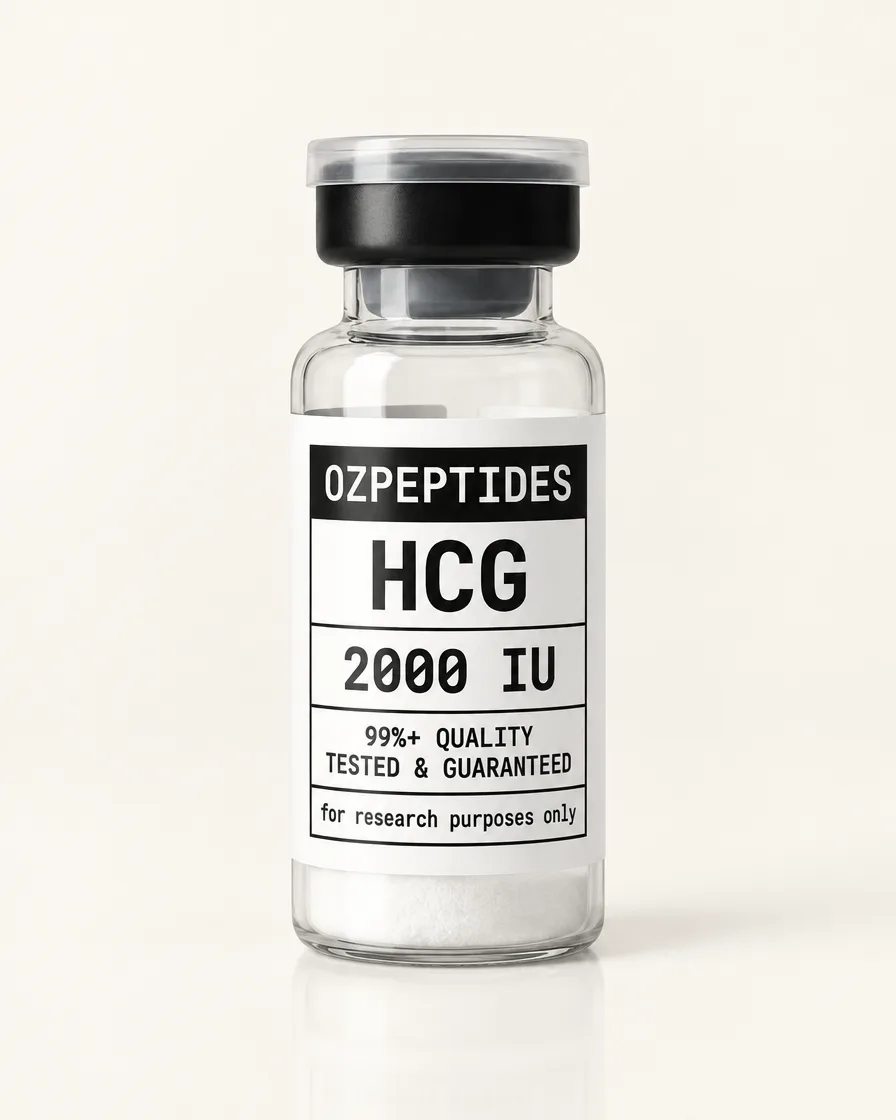
Research-grade HCG, made in Australia.
Specified by activity, as a glycoprotein should be: tested batch by batch with the IU stated on the results recorded against the batch on your vial.
Frequently asked
Not in the usual sense. It is a heterodimeric glycoprotein hormone with substantial carbohydrate modification, produced recombinantly or extracted rather than synthesised.
No. Controlled trials found no effect beyond the severe calorie restriction involved, and regulators have acted against hCG weight-loss products.
Yes, for male athletes. WADA S2 lists chorionic gonadotropin as prohibited in males at all times.
Because it is standardised by biological activity against a reference preparation, and glycosylation affects potency. Milligram and IU figures are not generally interconvertible.
The two share the same receptor. HCG binds the LH/CG receptor and lasts considerably longer in circulation.
Registered prescription medicines containing HCG exist. Research-grade HCG is a laboratory reagent, not one of them.
HCG is available in 2000IU, 5000IU and 10000IU.
- Cole LA. Biological functions of hCG and hCG-related molecules. Reprod Biol Endocrinol 2010;8:102.
This guide summarises published research for educational purposes. It is not medical advice. OzPeptides products are sold for research and laboratory use only, not for human consumption. 18+ only.