Key facts
What is MOTS-c?
MOTS-c is a short peptide encoded within mitochondrial DNA rather than the nuclear genome — one of a small group of mitochondrial-derived peptides.
For most of the history of cell biology, mitochondrial DNA was understood to encode a handful of respiratory-chain components and nothing else. MOTS-c, identified in 2015, belongs to a class that changed that picture: short open reading frames inside mitochondrial rRNA genes that produce signalling peptides. That origin is the interesting part scientifically — it implies the mitochondrion sends instructions to the rest of the cell, not just energy.
How does MOTS-c work?
Published work associates it with AMPK activation and with translocation to the nucleus under metabolic stress.
The most-cited mechanism is through the folate–methionine cycle and AMPK, the cell's energy-sensing kinase. Research has also reported that MOTS-c moves into the nucleus during metabolic stress and influences stress-response gene expression — an unusual behaviour for a peptide of this size, and one still being characterised. Much of the published data is from cell and rodent models; human data is limited, and honest research writing should say so.
What is MOTS-c studied for?
Metabolic regulation, insulin sensitivity, exercise physiology and ageing research.
Rodent studies have examined effects on insulin sensitivity and diet-induced obesity models. A separate strand looks at MOTS-c levels in relation to exercise and skeletal muscle, and another at age-related decline in circulating levels. It is an early-stage field: there are no large human trials, and the compound is used in laboratory research rather than as a therapeutic candidate with an approval pathway.
Is MOTS-c approved in Australia?
No. MOTS-c is not registered as a medicine anywhere and is a research compound only.
It is not registered in Australia. It is also worth noting for anyone in competitive sport that peptides of this kind fall under the WADA prohibited list's catch-all for substances with no current approval for human therapeutic use. OzPeptides supplies MOTS-c strictly for in-vitro and laboratory research, 18+, not for human consumption.
How is research-grade MOTS-c quality verified?
HPLC purity and mass-spec identity on every batch, with heavy-metal screening.
At 16 amino acids MOTS-c is a comparatively straightforward synthesis, which means a good batch should test very clean — there is less room to hide behind synthesis difficulty than with a 39-residue compound. Every OzPeptides batch is tested here in Australia at ≥99% HPLC purity with mass-spec identity confirmation and 0 ppm heavy metals, and those results are recorded against that batch.
What is a mitochondrial-derived peptide?
A peptide encoded in mitochondrial DNA rather than in the cell nucleus. MOTS-c is encoded within the 12S rRNA region of the mitochondrial genome.
This is what makes MOTS-c genuinely unusual rather than just another research peptide. Mitochondria were long treated as organelles that respire and little else; the discovery that the mitochondrial genome encodes short peptides with signalling roles opened a field. MOTS-c is one of a small handful — humanin was the first — and the concept that mitochondria signal to the nucleus, sometimes called retrograde signalling, is the framework the research sits in.
Who discovered MOTS-c, and when?
Lee and colleagues at the University of Southern California, published in Cell Metabolism in 2015.
The original paper described MOTS-c as regulating insulin sensitivity and metabolic homeostasis, with effects on the folate-methionine cycle and AMPK activation. That AMPK connection is the mechanistic thread through most of the subsequent work, since AMPK is the cell's energy sensor and the pathway metformin and exercise both converge on. The field is young — a decade of publications from a relatively small number of groups — which is the honest framing for the evidence.
How strong is the MOTS-c evidence?
Preclinical. Mouse and cell work is the bulk of it, with small exploratory human studies and no registrational trials.
MOTS-c has generated real scientific interest and a genuine mechanistic story, which is different from having clinical evidence. There is work on exercise capacity in aged mice, on insulin sensitivity, and on associations between a MOTS-c polymorphism and longevity in some human populations. None of that is a trial, and the gap between a compelling mechanism and a demonstrated effect in people is where most research compounds stop.
Is MOTS-c prohibited in sport?
It has no approval for human therapeutic use anywhere, placing it under the WADA S0 catch-all.
The exercise-capacity findings in animal models are exactly the sort of thing that attracts attention in sport, which makes the anti-doping status worth stating plainly. S0 covers substances with no current regulatory approval for human use, and MOTS-c has none. Athletes in any code following the World Anti-Doping Code should treat it as prohibited at all times.
How is MOTS-c stored and reconstituted?
Lyophilised, cold and dry, it is stable for long periods; reconstituted with bacteriostatic water and refrigerated, weeks.
MOTS-c is a short peptide of 16 residues and behaves like one: it dissolves readily and is not especially fragile, but the standard handling still applies. Bacteriostatic water rather than sterile gives a multi-draw window, the diluent goes down the side of the vial, and the vial is swirled rather than shaken. Keep it refrigerated and out of light once mixed.
What should be checked in a MOTS-c vial?
Identity by mass spectrometry and purity by HPLC. Short peptides are inexpensive to synthesise well, so a genuine batch should test very clean.
The corollary is that a mediocre purity figure on a compound this simple is a signal about the supplier rather than about the chemistry. We make MOTS-c in Blacktown, NSW, at ≥99% HPLC purity with 0 ppm heavy metals, and the batch number on the vial links to its certificate of analysis.
MOTS-c and the other mitochondrial peptides
Humanin was the first mitochondrial-derived peptide described, in 2001. MOTS-c followed in 2015, and the SHLP series after that.
Knowing the family matters because it frames how young this field is. Humanin came out of work on cell survival in Alzheimer's models and established that the mitochondrial genome encodes functional peptides at all — a claim that was contested before it was accepted. MOTS-c is the metabolically focused member, SHLP1 through SHLP6 the least characterised. The whole field rests on a relatively small number of groups and a couple of decades of publications, which is neither nothing nor a mature evidence base, and saying so is more useful than either overselling or dismissing it.
The exercise connection, and what it does and does not show
MOTS-c levels are reported to rise with exercise in humans, and administration is reported to improve exercise capacity in aged mice. Those are two different kinds of finding.
The human observation is correlational: a peptide whose concentration changes with activity may be a mediator, a marker, or a by-product, and the study design cannot distinguish them. The mouse result is interventional and genuinely suggestive, but mouse exercise capacity is a long way from any human claim. Conflating the two — reading "rises with exercise in people" plus "improves capacity in mice" as "improves exercise capacity in people" — is the most common misreading of this literature, and it is not supported.
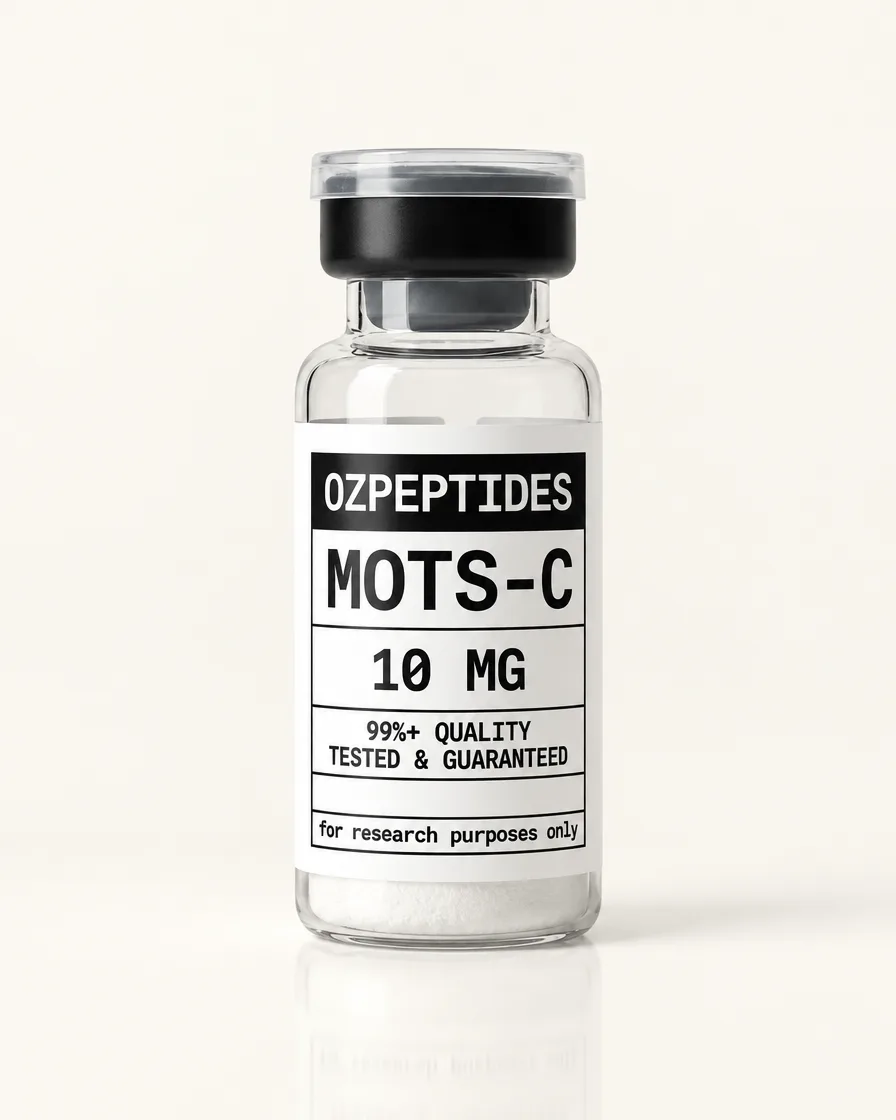
Research-grade MOTS-c, made in Australia.
Made and tested in our own Australian lab, in three strengths: ≥99% HPLC purity, mass-spec identity, 0 ppm heavy metals, tested batch by batch.
Frequently asked
Humanin, described in 2001. MOTS-c followed in 2015 and the SHLP series after that.
Administration is reported to do so in aged mice. Human data shows only that levels rise with exercise, which is correlational and a different kind of finding.
In mitochondrial DNA, within the 12S rRNA region — not in the cell nucleus like most peptides.
Lee and colleagues at the University of Southern California, published in Cell Metabolism in 2015.
The most-reported mechanism is AMPK activation, alongside effects on the folate-methionine cycle.
Only small exploratory work and population association studies. The evidence base is preclinical.
A 16-amino-acid peptide encoded in mitochondrial DNA, studied for its role in metabolic regulation and cellular stress response.
MOTS-c is available in 10MG, 20MG and 40MG.
No. It is supplied for research and laboratory use only.
- Lee C, et al. The mitochondrial-derived peptide MOTS-c promotes metabolic homeostasis and reduces obesity and insulin resistance. Cell Metab 2015;21:443–454.
- Reynolds JC, et al. MOTS-c is an exercise-induced mitochondrial-encoded regulator of age-dependent physical decline and muscle homeostasis. Nat Commun 2021;12:470.
This guide summarises published research for educational purposes. It is not medical advice. OzPeptides products are sold for research and laboratory use only, not for human consumption. 18+ only.